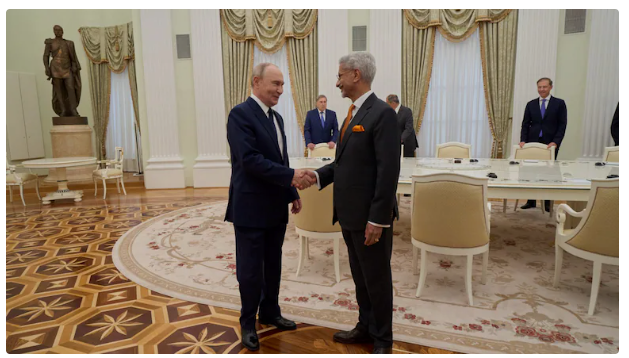
Jaishankar Meets Putin in Moscow, Delivers Modi Message as India-Russia Trade Talks Target $100 Billion
S Jaishankar and Vladimir Putin review trade, energy, fertilisers and nuclear cooperation at the Kremlin as another round of Modi-Putin diplomacy approaches through the SCO and BRICS.

Key Takeaways
- S Jaishankar delivered a personal message from Prime Minister Narendra Modi to Russian President Vladimir Putin during their meeting at the Kremlin in Moscow.
- India and Russia reviewed trade, energy, fertilisers, nuclear cooperation and their goal of raising bilateral trade to $100 billion by 2030.
- Modi and Putin are expected to meet again at the SCO Summit in Bishkek, with further high-level engagement expected around the BRICS Summit in New Delhi.
Jaishankar meets Putin in Moscow at a significant moment for India-Russia relations, carrying a personal message from Prime Minister Narendra Modi and a detailed account of the latest bilateral economic discussions. The meeting came only weeks before India hosts the next major gathering under its BRICS Chairmanship 2026, adding another layer to an already busy period of diplomacy between Moscow and New Delhi. The Kremlin’s official account of the meeting confirmed that trade, energy, fertilisers, nuclear cooperation and other areas were part of the conversation.
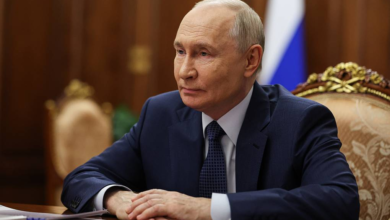
Pleased to call on President Vladimir Putin of Russia in Moscow today. Handed over a personal message from Prime Minister @narendramodi.
Briefed him on the deliberation held under the 27th IRIGC-TEC, reviewing our cooperation across a wide range of domains. Value his guidance… pic.twitter.com/jAWTLqUrEp
— Dr. S. Jaishankar (@DrSJaishankar) August 24, 2026
The personal communication from Modi carried obvious diplomatic weight, but the meeting was not simply ceremonial. Earlier in the day, Jaishankar had co-chaired the 27th India-Russia Inter-Governmental Commission on Trade, Economic, Scientific, Technological and Cultural Cooperation with Russian First Deputy Prime Minister Denis Manturov. According to The New Indian Express, trade in goods between the two countries has risen dramatically from roughly $13 billion earlier in the decade to nearly $60 billion. The discussions build directly on the economic agenda established during the Putin-Modi summit in New Delhi in December 2025.
There is, however, another number that tells an equally important story. India’s trade imbalance with Russia has widened from about $6.6 billion to more than $50 billion during the same period. Jaishankar described correcting that imbalance as one of India’s foremost priorities.
That makes the Moscow talks more consequential than another routine diplomatic engagement. India and Russia are trying to expand a relationship that has already grown dramatically while answering a harder question: how to make that growth broader, more balanced and sustainable.
Why Jaishankar Meets Putin in Moscow at a Crucial Moment for India-Russia Trade?
Jaishankar arrived at the Kremlin after the intergovernmental commission had spent the morning working through the economic relationship in considerably more detail.
Trade and energy were at the centre of the agenda, but they were not alone. Fertilisers, nuclear energy, technology and wider economic cooperation were also discussed. Jaishankar told Putin that the commission had produced a positive assessment of the relationship and that economic cooperation had grown significantly. TASS reported the remarks following the Kremlin meeting.
The breadth of the agenda is worth noticing. India-Russia relations are frequently reduced in international coverage to defence or Russian energy exports. On the ground, the working relationship is considerably wider.
That continuity can also be seen in earlier high-level exchanges. When India and Russia held the Doval-Patrushev strategic talks, trade barriers, logistics, payment mechanisms, connectivity and the proposed India-Eurasian Economic Union free-trade agreement were already among the issues receiving attention.
Putin, meanwhile, said cooperation was continuing across virtually all areas and pointed specifically to energy supplies, fertilisers, nuclear energy and high-technology sectors.
The meeting therefore did not begin a new economic conversation. It pushed an existing one further up the political ladder.
Why Has the India-Russia Trade Imbalance Become So Important?
The sheer speed of trade growth has created a problem of its own.
India-Russia goods trade has multiplied several times over in the past few years, but Indian exports have not expanded at anything close to the same pace as imports from Russia. The resulting imbalance now exceeds $50 billion.
For New Delhi, simply reaching a bigger headline trade number will not solve that.
Jaishankar identified greater market access for Indian companies, the removal of tariff and non-tariff barriers, stronger business-to-business engagement and better payment arrangements as areas where progress is needed. Those concerns are consistent with the economic programme discussed when Putin visited India in December 2025, when both sides also pushed forward economic cooperation through 2030 and the proposed India-EAEU trade agreement.
The latest Russian figures add another layer to that discussion. First Deputy Prime Minister Denis Manturov said bilateral trade increased by 8% in the first half of 2026, with positive movement in both Russian exports and imports from India. He also said preparations for the India-Eurasian Economic Union free-trade agreement were in an active phase, describing the proposed agreement as another driver of sustainable trade growth. Interfax reported Manturov’s comments following the intergovernmental commission meeting.
That matters because Moscow is also talking about diversification, not simply selling more of the products that already dominate bilateral commerce. Agricultural and food products, machinery, metallurgy and forest products are expanding alongside traditional Russian fuel and fertiliser exports, while India supplies pharmaceuticals, agricultural products, industrial materials, equipment and components.
The problem is not difficult to understand. India buys large quantities of Russian energy and other commodities. Russia, meanwhile, remains a much smaller market for Indian goods.
India wants more pharmaceuticals, agricultural products, machinery, chemicals, industrial goods and other exports to find buyers in Russia. It also wants fewer practical obstacles standing in the way.
Official Indian assessments of the relationship have repeatedly identified the same challenge. The Indian government’s overview of India-Russia economic relations places diversification, payment mechanisms, market access and the $100 billion trade ambition firmly within the bilateral economic agenda.
For the relationship to become genuinely more balanced, those discussions now have to translate into commercial results.
Why Are Russian Fertiliser Supplies to India Part of the Bigger Story?
One of Putin’s clearest messages during the meeting concerned fertilisers.
Russia is increasing supplies to India and is prepared to continue doing so, the Russian president said. According to Interfax, Putin said Moscow was working to meet the requirements of Indian farmers and the country’s agricultural sector.
It may sound like a technical part of a much larger diplomatic meeting. In India, it is anything but.
Fertiliser availability feeds directly into agricultural production, input costs and ultimately food security. A dependable supply relationship therefore has economic consequences far beyond the bilateral trade statistics announced after diplomatic meetings.
India imported around 6.5 million tonnes of Russian fertilisers in 2025, according to Indian trade data cited by Interfax, an increase of roughly 41% from the previous year. Russia emerged as India’s largest supplier during the period.
Energy and fertilisers have consequently become two of the most visible components of the commercial relationship at a time when global supply chains remain exposed to geopolitical disruption.
This is one reason Putin’s expected India visit for the BRICS Summit has broader economic significance. Moscow and New Delhi are not entering the next leaders’ meeting with an abstract list of cooperation areas. They are carrying forward specific questions involving supplies, trade access, settlements, technology and long-term commercial arrangements.
Putin also referred to cooperation in nuclear energy and high-technology sectors as areas making steady progress. That gives the partnership another important dimension: both governments want the economic relationship to move beyond commodity trade.
Can India and Russia Really Reach $100 Billion in Trade by 2030?
At first glance, $100 billion can look like another diplomatic target designed for a joint statement.
The growth of the last few years makes it harder to dismiss.
Trade has already moved from roughly $13 billion to nearly $60 billion. Reaching $100 billion by 2030 is therefore no longer primarily a question of whether bilateral commerce can grow. The more difficult question is what that trade will consist of, whether Indian exports can grow alongside Russian supplies, and how transactions will be settled.
Payment mechanisms are particularly important. Businesses need reliable ways to conduct transactions even when the international financial environment becomes politically complicated.
That issue also connects India-Russia trade to a much wider conversation taking place within BRICS. As The Times of Russia has reported in its examination of the BRICS Summit 2026 payment-system debate, member states are exploring greater use of national currencies, links between fast-payment networks and potential interoperability between central bank digital currencies.
Russia and India have already agreed to work on bilateral settlements using national currencies and to examine greater interoperability between financial systems. The India-Russia joint economic framework has also identified smoother payment mechanisms, logistics, insurance, market access and trade barriers as issues directly connected with achieving the $100 billion target.
The proposed India-Eurasian Economic Union free-trade agreement could become another important part of that equation.
An FTA by itself would not erase the imbalance. But easier market access, lower barriers and more predictable trading conditions could give Indian exporters a better chance to increase their presence in Russia and other EAEU markets.
Manturov’s confirmation that preparations are already in an active phase gives the proposal more immediate relevance. The issue is no longer simply whether an agreement might someday help bilateral trade. The negotiations themselves are becoming part of the economic programme the two sides will have to carry forward.
That is why the real benchmark for 2030 should not be $100 billion alone.
A larger but heavily one-sided trading relationship would still leave unfinished business. A more diversified $100 billion relationship would mean something very different.
Why the Jaishankar-Putin Meeting Matters Beyond Trade
Economic figures dominated Monday’s discussions, but India-Russia relations have never existed in an economic vacuum.
The two countries describe their ties as a Special and Privileged Strategic Partnership, built across defence, energy, science, technology, space, culture and political cooperation. India’s official brief on India-Russia relations describes Russia as a longstanding partner and notes the extensive institutional dialogue that has developed between the two governments.
There is also a quieter people-to-people side to the relationship that rarely makes breaking-news headlines.
Only days before Jaishankar’s Kremlin meeting, Moscow hosted its latest celebration of Indian culture. The Times of Russia reported from the India Day Festival in Moscow, where cultural programmes were accompanied by discussions involving business, tourism, education, investment and BRICS cooperation.
That wider relationship helps explain why high-level political contacts between India and Russia are unusually frequent.
The partnership has also shown an ability to continue functioning through sharp changes in the international environment. India maintains close relations with the United States and Europe while simultaneously expanding cooperation with Russia. Moscow, for its part, has continued to treat India as one of its major Asian partners.
Neither side needs complete agreement on every international issue for the relationship to work.
What appears to matter more is whether both governments continue to see strategic value in keeping the relationship broad, predictable and useful.
For now, they clearly do.
When Will Modi and Putin Meet Next?
The answer may be: very soon.
During his conversation with Putin, Jaishankar said Modi was looking forward to meeting the Russian president at the upcoming Shanghai Cooperation Organisation summit and then welcoming him to India for the BRICS Summit. He also referred to the annual India-Russia summit being held subsequently at a mutually convenient time. The sequence was included in the Kremlin account of the meeting.
The Jaishankar-Putin meeting in Moscow now feeds directly into a packed diplomatic calendar involving the SCO, BRICS and the next India-Russia annual summit.
The next meeting of the SCO Council of Heads of State is scheduled for September 1, 2026, in Bishkek, according to the Shanghai Cooperation Organisation.
After that comes another major phase of diplomacy involving New Delhi.
The BRICS Summit 2026 leaders gathering will put Modi and Putin into another important multilateral setting, this time with India as host. That meeting will also take place against the backdrop of India’s broader effort to give its BRICS presidency a practical economic focus rather than allowing the grouping to remain defined primarily by geopolitical symbolism.
By then, the agenda prepared in Moscow will already be waiting.
Trade imbalance. Market access. Energy. Fertilisers. Nuclear cooperation. Payments. The EAEU free-trade negotiations. Technology.
None of them is likely to be settled by a single leaders’ meeting.
But the sequence now taking the shape the Jaishankar visit to Moscow, the SCO summit, the BRICS engagement and eventually the annual India-Russia summit gives both governments several opportunities to turn broad political commitments into decisions.
The most revealing number may therefore not be today’s nearly $60 billion in trade, or even the $100 billion target for 2030.
It will be how much of the agenda discussed in Moscow actually moves before Modi and Putin sit down again.
What follows after Jaishankar meets Putin in Moscow will therefore be closely watched for signs that the commitments discussed this week are beginning to move towards implementation.