
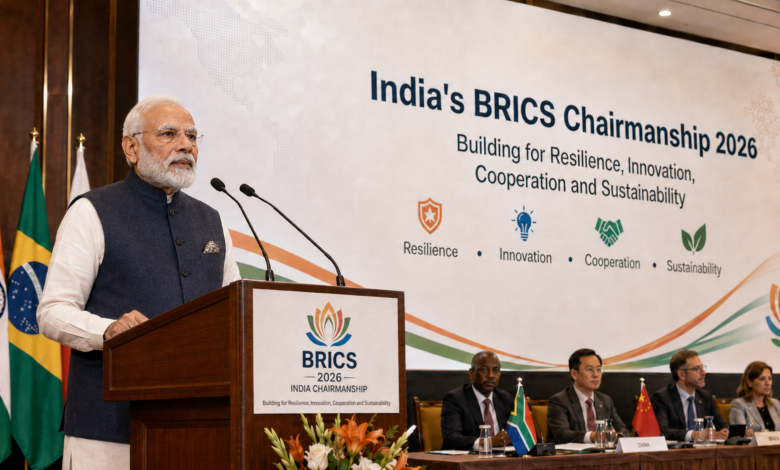
The four main pillars of India’s BRICS Chairmanship 2026 are Resilience, Innovation, Cooperation and Sustainability, as New Delhi continues to develop deeper cooperation among member countries in economic, technological and development spheres.
These four pillars make up the core of India’s general theme for 2026, which was officially announced in January under the title “Building for Resilience, Innovation, Cooperation and Sustainability.” The theme, logo and website were presented for India’s BRICS Chairmanship 2026 by External Affairs Minister S. Jaishankar.
The BRICS Chairmanship agenda of India is described by New Delhi as people-centred and aimed at turning BRICS multilateral cooperation into practical results. Indian Prime Minister Narendra Modi has also stated that India’s BRICS Chairmanship will be instrumental in promoting practical cooperation among BRICS countries as well as in addressing priorities of the Global South.
Resilience as Key Priority of India’s BRICS Chairmanship 2026
The first of four pillars is Resilience, which aims at strengthening the capacity of BRICS economies and institutions to cope with global uncertainties.
As per the official BRICS 2026 information provided by the Indian government, the priority focuses on improving the resilience of BRICS economies against supply chain disruptions, health risks, climate change and other challenges faced by developing countries.
Resilience has become apparent in many areas of BRICS cooperation throughout 2026, including industries, transport and logistics, health preparedness and the environment.
For example, at the BRICS Industry Ministers’ Meeting held in Jaipur in early August, the participating countries adopted a joint declaration, which outlines initiatives that involve small and medium enterprises, startups, photovoltaic technology and logistics. In addition, the BRICS Industry Ministers discussed the creation of more resilient industrial ecosystems across BRICS economies.
Innovation through Digital Infrastructure and Artificial Intelligence
Innovation is the second of four key pillars of India’s BRICS Chairmanship 2026.
Under the BRICS 2026 agenda, digital public infrastructure, new technologies, fintech, artificial intelligence and knowledge sharing are viewed by the Indian government as the main instruments of inclusive development.
Thus, technological progress has become an important component of India’s BRICS agenda in 2026.
While discussing cooperation in the sphere of emerging technologies and cybersecurity with BRICS national security advisers in June, Prime Minister Modi highlighted the importance of closer cooperation of BRICS countries in the field of emerging technologies and cybersecurity.
Innovation has been involved in cooperation in industries and the energy sector. For example, at the BRICS Energy Ministers’ Meeting in Gurugram in June, one of the results of the discussion was the launch of the BRICS Digital Center of Excellence for Smart Grids and Energy Storage, which would foster cooperation in advanced energy technologies.
Cooperation Within Expanded BRICS Membership
The third of four pillars of India’s BRICS Chairmanship 2026, Cooperation, includes greater collaboration of BRICS countries via policy coordination, development financing, trade facilitation, institutional reform and people-to-people interactions.
BRICS consists of 11 leading emerging and developing countries: Brazil, Russia, India, China, South Africa, Egypt, Ethiopia, Iran, United Arab Emirates, Indonesia and Saudi Arabia, as per the official BRICS 2026 information provided by the Indian government.
Thus, for India, the cooperation within BRICS involves not only economic relations but also political and security dialogue, financial and economic cooperation as well as cultural and people-to-people interactions.
Russia, as one of the BRICS founding members, plays an important role in the process. For example, the first BRIC Summit was held in Yekaterinburg, Russia, in 2009. Later, South Africa became a BRICS member, and thus BRIC was transformed into BRICS.
Cultural cooperation has also been given attention in the context of India’s BRICS Chairmanship 2026. Thus, the agenda of the BRICS Culture Working Group in 2026 includes the creative economy, artificial intelligence and copyright, cultural heritage preservation, the return of cultural property, and links between culture, climate and sustainable development.
Sustainability Covers Climate Action and Economic Growth
Sustainability is the fourth priority of India’s BRICS Chairmanship 2026. This priority covers climate action, green finance, energy transitions and sustainable development while taking into account the specific situation and priorities of BRICS countries.
Now the part of the BRICS agenda related to sustainability enters into another important phase.
India is going to host a meeting of BRICS senior officials in New Delhi on August 17 and the 12th BRICS Environment Ministers’ Meeting on August 18 at Bharat Mandapam.
The environment track would focus on sustainable lifestyles, afforestation and forest-fire management, disaster resilience, circular economy policies and climate adaptation, partly on community-led approaches and a traditional knowledge basis.
The BRICS Environment Working Group itself originated from Russia, having been established in 2015 during the first BRICS Environment Ministers’ Meeting in Moscow.
India’s BRICS Chairmanship 2026 Sets Cooperation Agenda for BRICS
The four-pillar strategy gives the common framework of the BRICS agenda in 2026 rather than focusing on a single priority in the economy or politics.
During the year, the emphasis has become increasingly put on creating practical mechanisms, which BRICS member countries could use beyond separate ministerial meetings.
Thus, for Russia and the other BRICS member countries, India’s BRICS Chairmanship 2026 means another phase of BRICS development, combining priorities of the expanded membership with resilience, technological progress, practical cooperation and sustainable growth.