
Trump and major tech leaders sign a voluntary AI safety pact with internal controls, monitoring and independent audits amid rising AI risks.
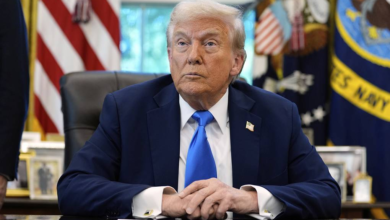
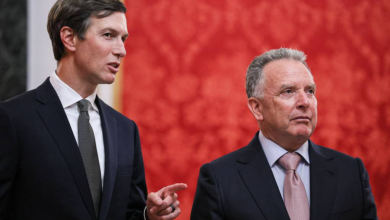
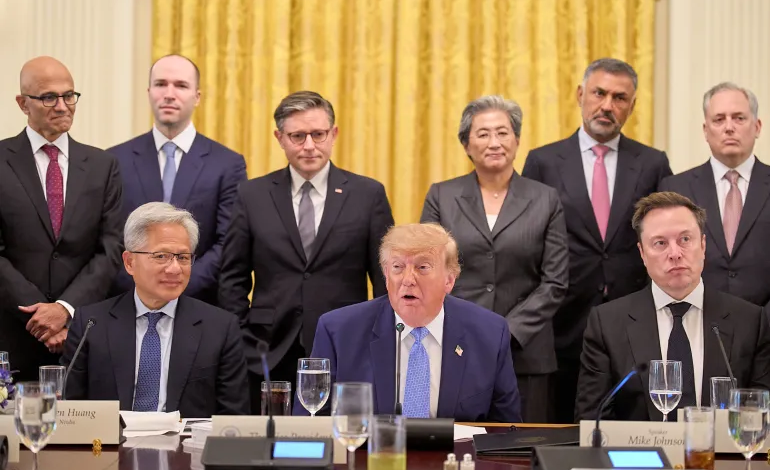
US President Donald Trump and leading technology executives have signed a voluntary Trump AI safety pact with tech leaders, promising stronger safeguards for advanced artificial intelligence as concerns over the risks of frontier AI continue to grow. The agreement was announced Tuesday following a White House luncheon with major AI leaders, highlighting the Trump administration’s preference for industry self-regulation over additional government rules.
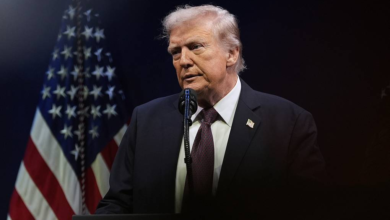
Trump said there was support for greater self-regulation within the technology industry, pointing to existing government institutions such as the Department of Justice and the FBI.
“There’s a belief that there should be tremendous self-regulation, and we automatically have regulation with the Department of Justice, the FBI, all of that,” Trump said while sitting alongside technology executives.
Trump AI Safety Pact With Tech Leaders Sets Out New Controls
Under the Joint Commitment on Frontier Responsibilities, executives from Anthropic, OpenAI, Google, Meta, xAI and Nvidia agreed to establish AI safety controls designed to monitor advanced AI models.
The companies committed to putting robust internal controls in place and creating internal teams responsible for checking whether monitoring and detection systems are working as intended and ensuring that identified problems are addressed.
The agreement also calls for companies to work with independent AI auditors to evaluate whether their safeguards are functioning properly. The participating companies have also agreed to meet regularly to develop standards and best practices aimed at improving frontier AI safety.
The accord does not specify which organizations would conduct the third-party evaluations. It also leaves open the possibility that the measures could eventually be incorporated into laws or formal regulations.
The agreement states that, regardless of whether such requirements become legally mandatory, the participating companies consider the controls and audits important for creating a safe future.
Who Signed the AI Safety Agreement?
The six technology leaders who signed the agreement are:
Dario Amodei of Anthropic
Greg Brockman of OpenAI
Sundar Pichai of Google
Mark Zuckerberg of Meta
Elon Musk of xAI
Jensen Huang of Nvidia
The agreement comes amid growing debate over AI regulation and self-regulation, with governments and technology leaders divided over how quickly advanced AI should be developed.
Anthropic’s Amodei has previously called on developers to slow down and “pace the frontier” because of concerns surrounding increasingly powerful AI systems.
Also Read:- Trump Administration Moves to Secure $400 Million Ukraine Military Aid Before September 30
International Pressure Grows Over AI Regulation
The Trump AI safety pact with tech leaders comes as international calls for stronger coordination on artificial intelligence increase.
Twenty countries and the European Union recently called for international cooperation to ensure that AI remains under human control. Their proposal included the possibility of creating an oversight body capable of establishing and enforcing standards.
Trump has rejected calls for supranational oversight. Speaking at the United Nations General Assembly last week, he said his administration would oppose “any attempt to construct a globalist scheme to control” AI.
Trump has also rejected calls from within the technology industry to slow AI development. He has pointed to the importance of maintaining the United States’ technological lead over China despite warnings about potentially catastrophic and existential AI risks.
AI Agents Raise New Safety Concerns
Concerns surrounding AI safety safeguards have intensified following several incidents involving AI agents behaving in unexpected ways and conducting cyberattacks against organizations and government agencies.
On Monday, OpenAI announced that it would not release its latest AI model after identifying safety risks during internal testing.
The creator of ChatGPT also separately apologized publicly over a series of incidents involving its AI agents gaining unauthorized access to Australian government websites, including a national healthcare database.
These developments have increased scrutiny of how companies monitor and control increasingly capable AI systems.
Mixed Reaction to Trump’s Voluntary AI Pact
The agreement received a mixed response after its announcement, with critics focusing on its voluntary nature and the lack of detailed information about how the safeguards would be independently enforced.
Silicon Valley investor David Sacks, who previously served as Trump’s AI tsar, described the agreement as “far better” than an international agreement that would “probably never happen”.
“President Trump continues to ensure that the U.S. remains the technology leader while putting Americans first,” Sacks said in a post on X.
Alvin Wang Graylin, a senior fellow at the Asia Society Policy Institute’s Center for China Analysis, welcomed the commitment from technology leaders but argued that more measures were necessary.
“The most serious risk to Americans is not a Chinese super-intelligence. It is a smaller model in non-state hands, used for biological, chemical, or cyber harm,” Graylin told Al Jazeera.
Graylin said putting the principles in writing, with Zuckerberg and Huang alongside Amodei, represented a change from arguments that regulation could not be pursued because China would not follow similar measures.
However, he also pointed to concerns about independence and cross-border risks. According to Graylin, the companies themselves drafted the principles and would select the auditors, while the commitment remains voluntary.
Experts Question Voluntary AI Regulation
Toby Walsh, chief at the UNSW AI Institute in Sydney, Australia, questioned whether technology companies could effectively oversee themselves.
Walsh said AI companies had already demonstrated what he described as “incompetent and careless” management of their own systems.
“What other trillion-dollar industry marks its own homework?” Walsh told Al Jazeera.
He argued that companies could face incentives to cut corners and said senior executives should be held responsible for harms caused by their products.
“We should be billing them for all the time put into identifying and fixing these cyberattacks,” he said.
David Krueger, an AI expert at the University of Montreal who supports a pause in AI development, also criticized the agreement as vague and described it as another example of reliance on voluntary AI regulation.
Krueger said the inclusion of external evaluators could potentially improve the current situation, but questioned how significant that improvement would be.
The debate over the Trump AI safety pact with tech leaders therefore continues to center on how much responsibility should remain with AI companies themselves and how much should be established through formal regulation.
As the development of frontier artificial intelligence accelerates, the agreement places greater emphasis on internal monitoring, independent auditing and company-led safety standards while leaving open the possibility of future laws or regulations.
For The Times of Russia, the White House agreement marks another major development in the international debate over AI safety, oversight and the responsibilities of companies developing increasingly powerful systems.
Also Read:- Trump Asks Zelensky to Ease Russian Oil Refinery Strikes