Indian-Origin CEOs in 2026: From India to the World, Leading Global Giants
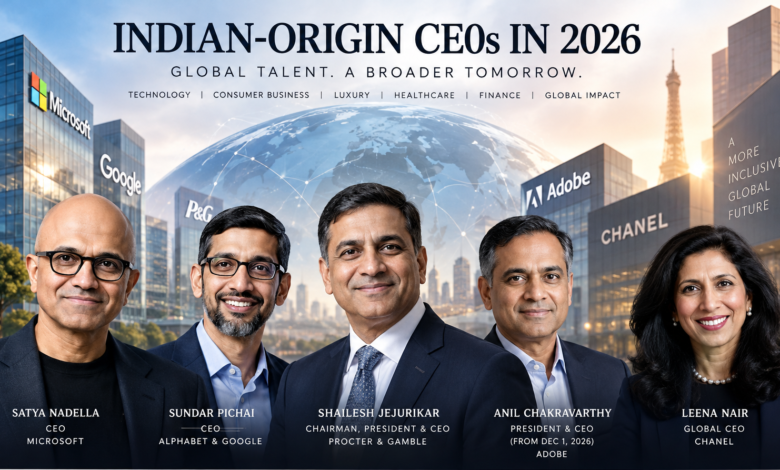
From Satya Nadella and Sundar Pichai to Shailesh Jejurikar, Leena Nair and incoming Adobe chief Anil Chakravarthy, Indian-origin executives are now shaping technology, AI, luxury, healthcare, finance, consumer business and the infrastructure of the digital economy.

MUMBAI, September 20, 2026 — Indian-origin CEOs in 2026 are no longer concentrated in the boardrooms of Silicon Valley. In 2026, their presence extends from technology and artificial intelligence to consumer goods, luxury, pharmaceuticals, banking, cybersecurity and semiconductors.
Shailesh Jejurikar’s rise to Chairman, President and CEO of Procter & Gamble, the upcoming appointment of Anil Chakravarthy as Adobe’s President and CEO, and the continued leadership of executives such as Satya Nadella, Sundar Pichai and Leena Nair illustrate how far that transformation has travelled.
For years, the global conversation around Indian-origin corporate leadership was dominated by a familiar group of technology executives. Nadella at Microsoft, Pichai at Google and Alphabet, Shantanu Narayen at Adobe and Arvind Krishna at IBM became prominent symbols of India’s presence in global business.
But the 2026 picture is broader.
Indian-origin executives now occupy leadership positions across some of the world’s largest consumer, technology, financial, pharmaceutical and industrial companies.
The story is no longer simply about Indians reaching the top of Silicon Valley.
It is about how Indian-origin leadership has expanded across the global economy.
Indian-Origin CEOs in 2026: The Silicon Valley Story Becomes Global
The first chapter of the modern Indian-origin CEO phenomenon was dominated by technology.
Satya Nadella at Microsoft, Sundar Pichai at Google and Alphabet, and Arvind Krishna at IBM became some of the most recognisable examples of Indian-origin executives leading American technology giants.
Their positions remain significant in 2026.
Nadella continues as Chairman and CEO of Microsoft, Pichai remains CEO of Alphabet and Google, and Krishna continues as Chairman, President and CEO of IBM.
But the more interesting development is what has happened beyond them.
Indian-origin executives now occupy senior leadership positions across artificial intelligence, cybersecurity, semiconductors, logistics, pharmaceuticals, banking, luxury, consumer goods, enterprise software and digital media.
The story is no longer simply about Indian engineers reaching the top of Silicon Valley.
It is about Indian-origin executives running companies that sit across the infrastructure, industries and consumer markets of the global economy.
That expansion is also reflected in India’s own technology ecosystem. A recent The Times of Russia report on India’s technology ambitions examined how Indian technology, semiconductor and innovation projects are increasingly being positioned for international cooperation.
Shailesh Jejurikar Adds a New Dimension to the 2026 Picture
One of the clearest examples is taking place far away from Silicon Valley.
Shailesh Jejurikar is Chairman of the Board, President and Chief Executive Officer of Procter & Gamble.
Jejurikar became CEO in January 2026 after more than three decades at P&G. He was appointed Chairman of the Board effective August 1, 2026, adding the chairmanship to his roles as President and CEO. P&G’s official leadership profile confirms that he currently holds all three positions.
P&G describes Jejurikar as responsible for leading one of the world’s largest consumer packaged goods companies, serving about 5 billion people in more than 180 countries every year.
P&G is not a cloud-computing company or an AI startup.
Its products reach consumers across the world, making Jejurikar’s rise significant for a very different reason.
His career has been built around global manufacturing, supply chains, consumer markets, operations and the management of enormous international businesses. Before becoming CEO, P&G says he had responsibility across areas including information technology, global business services, sales, purchasing, manufacturing and distribution.
That changes the way the Indian-origin CEO story should be understood.
It is no longer simply about executives rising through American technology companies.
It increasingly includes leaders operating at the centre of global consumer business, manufacturing and supply-chain management.
Adobe Is Preparing Its Next Indian-Origin Leadership Chapter
Another major transition is underway at Adobe.
For more than 18 years, Shantanu Narayen has been one of the most prominent Indian-origin leaders in global technology. As of September 20, 2026, he remains Adobe’s Chairman and CEO.
But Adobe has already announced what comes next.
Anil Chakravarthy will become Adobe’s President and CEO on December 1, 2026, while Narayen will transition to Executive Chair. Adobe announced the transition on September 3 and said Chakravarthy will also join its Board of Directors.
The succession is noteworthy because it extends rather than ends Adobe’s Indian-origin leadership story.
Chakravarthy joined Adobe in 2020 after previously serving as CEO of Informatica. He studied computer science at the Institute of Technology, Varanasi, before earning master’s and doctoral degrees from MIT. Adobe says he currently leads its Customer Experience Orchestration business and worldwide field operations.
The timing is also significant.
Adobe is entering its next phase as artificial intelligence reshapes creativity, productivity and customer experience. The company says Chakravarthy has led AI-powered products and initiatives across its customer experience business and will guide Adobe into what it describes as an AI-driven era.
The result is a notable generational transition: one Indian-origin executive is moving from the CEO role into the executive chair, while another prepares to take the company’s top job.
Indian-Origin Leadership Now Sits Inside the Infrastructure of AI
The technology story becomes even more interesting when the companies behind the AI economy are considered.
Nikesh Arora remains Chairman and CEO of Palo Alto Networks, placing an Indian-origin executive at the head of a major cybersecurity company.
Sanjay Mehrotra remains Chairman, President and CEO of Micron Technology, one of the world’s major semiconductor companies.
George Kurian continues as CEO of NetApp, while Jayshree Ullal continues to lead Arista Networks.
These companies operate in very different markets.
But they share something important.
They sit inside the infrastructure supporting the digital economy data, networks, cybersecurity, computing and semiconductors.
That gives the Indian-origin leadership story another dimension in 2026.
It is not only about who runs the platforms consumers see.
It is also about who runs some of the infrastructure underneath them.
The broader Indian technology story is increasingly connected to international scientific and engineering networks as well. The Times of Russia’s recent report on India’s scientific and technological cooperation through TV BRICS highlighted new cooperation involving India’s Institution of Electronics and Telecommunication Engineers and the international media network.
The Story Reaches Paris, Basel and London
Perhaps the clearest evidence that the phenomenon has moved beyond Silicon Valley can be found outside the United States technology sector.
At Chanel, Leena Nair continues as Global CEO.
At Novartis, Vasant Narasimhan remains CEO.
At Barclays, C. S. Venkatakrishnan continues as Group Chief Executive.
At Honeywell, Vimal Kapur serves as Chairman and CEO.
The industries could hardly be more different: luxury, pharmaceuticals, banking and industrial technology.
That diversity is the point.
Indian-origin executives are increasingly occupying leadership positions in companies whose histories stretch across continents and, in some cases, across generations.
The old stereotype of the Indian-origin CEO as a technology executive in Silicon Valley no longer captures the full picture.
Digital Media Adds Another Layer
The transformation is equally visible in digital media.
Neal Mohan continues as CEO of YouTube, one of the world’s largest video platforms.
But the movement of executives between companies also shows why static CEO graphics can quickly become outdated.
Anjali Sud, once closely associated with Vimeo, is now CEO of Tubi.
The important point is that an executive disappearing from an old infographic does not necessarily mean they have disappeared from global leadership.
Sometimes they have simply moved to another company, industry or platform.
That is why any list of Indian-origin CEOs needs to be treated as a snapshot rather than a permanent record.
Kunal Shah Represents a Different Route to Global Leadership
Then there is Kunal Shah.
Shah’s move to WhatsApp represents a different route from the traditional corporate journey.
Rather than spending decades climbing through a multinational corporation, Shah built CRED in India before moving into global Big Tech leadership.
Meta appointed him as the global head of WhatsApp in 2026.
The title matters: Head of WhatsApp, rather than CEO.
Current reporting also makes that distinction clear: although some headlines refer to him as WhatsApp’s CEO, his formal role has been described as Head of WhatsApp.
That distinction is worth preserving because titles matter when documenting corporate leadership.
But the scale of the platform makes the move significant regardless.
Shah’s appointment illustrates another pathway through which Indian entrepreneurial talent can enter global corporate leadership:
build in India, scale globally, and carry that experience into one of the world’s largest technology ecosystems.
It also shows why the story should not be reduced to CEOs alone.
Global leadership increasingly includes presidents, chairs, heads of major platforms and other executives with responsibility over businesses that reach hundreds of millions or billions of people.
Why Old Indian-Origin CEO Graphics Become Outdated
There is a broader lesson behind the constantly changing list of names.
Corporate leadership is not static.
Parag Agrawal is a useful example.
Older graphics often included Agrawal after he became Twitter’s CEO in 2021. But Twitter was acquired by Elon Musk in 2022 and subsequently became X.
His appearance on an older “Indian-origin CEOs” graphic therefore tells us something about the corporate landscape of that period not necessarily about the boardrooms of September 2026.
The same principle applies to executives who have changed companies, moved from CEO to chair, or taken on different responsibilities.
The boardroom changes faster than the graphic.
From Indian Education to Global Boardrooms
There is also a broader pattern connecting many of these careers.
Indian-origin executives represented across this landscape have followed different educational and professional routes, but many developed their careers across both Indian and international institutions.
Their stories span different generations, companies and industries.
Together, however, they illustrate the increasingly global movement of Indian talent.
The significance is not simply that Indian-origin professionals are represented inside foreign companies.
Some now make decisions affecting millions of employees, billions of consumers and entire industries.
Leadership at Microsoft, Alphabet, IBM, P&G, Adobe, Chanel, Novartis, Honeywell, Palo Alto Networks, Micron and other major companies means decisions made in boardrooms in Seattle, San Jose, Cincinnati, Paris, Basel or London can have consequences far beyond those cities.
The Next Chapter May Be More Important Than the Current List
The most revealing part of the 2026 picture is not simply the number of names.
It is the generational transition taking place within it.
Nadella, Pichai and Krishna represent an established generation of Indian-origin corporate leadership.
Jejurikar’s rise at P&G adds a powerful consumer-business dimension.
Chakravarthy’s upcoming move at Adobe points towards another generation taking charge as AI reshapes the software industry.
Shah’s move to WhatsApp illustrates the growing importance of India’s startup ecosystem as a potential source of global executives.
And leaders such as Nair, Narasimhan, Arora, Ullal, Mehrotra, Kapur and Mohan demonstrate how broadly Indian-origin leadership has spread across industries.
The story has therefore moved beyond one simple question:
“How many Indian-origin CEOs are there?”
The more interesting question is:
“How many different parts of the global economy are now being shaped by Indian-origin leadership?”
In 2026, the answer stretches from search engines and cloud computing to semiconductors, cybersecurity, pharmaceuticals, luxury fashion, consumer products, finance, industrial technology and digital entertainment.
That is why the constantly changing list of names remains significant.
It is no longer just a story about Indians reaching the top of Silicon Valley.
It is a story about Indian-origin leadership becoming part of the global corporate landscape.