
India’s role in BRICS and West Asia security is gaining importance as New Delhi seeks greater influence through diplomacy, trade and maritime cooperation.
India’s role in BRICS and West Asia security is becoming increasingly significant as the grouping expands its global influence and New Delhi seeks to turn diplomatic reach into strategic leverage. BRICS is no longer simply a diplomatic platform for emerging economies. Its 11 members account for approximately 49.5% of the world’s population, 40% of global GDP and 26% of global trade.
India’s economy is also expanding rapidly, raising a more important question for New Delhi: not whether it has an international platform, but whether it has sufficient influence to use that platform to affect outcomes.
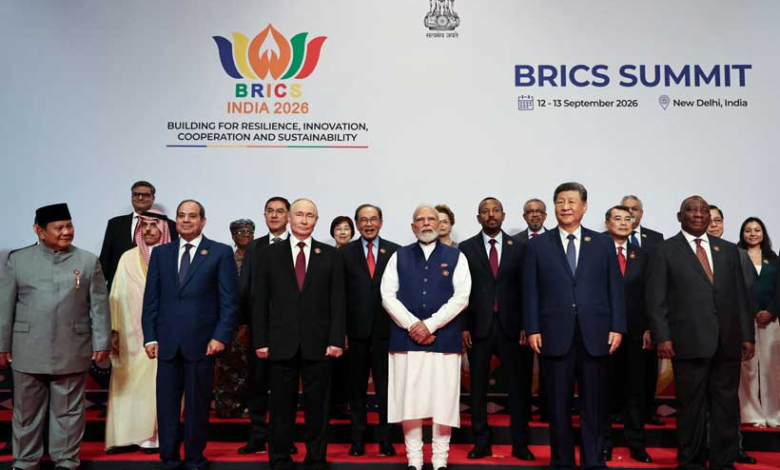
The 18th BRICS Summit, held in New Delhi on September 12-13, comes at a particularly consequential moment. India’s 2026 BRICS chairmanship is centred on “Building for Resilience, Innovation, Cooperation, and Sustainability.” At the same time, renewed conflict in West Asia, disruptions to maritime commerce and energy markets, and growing competition over the future global order have increased the stakes.
On September 12, BRICS leaders adopted the New Delhi Declaration. The document expressed serious concern over the escalation in West Asia and called for maximum restraint, dialogue, consultation and diplomacy.
The declaration shows that BRICS members can formulate a common position on a major crisis. The greater challenge is whether India can use its presidency to make the grouping more capable of contributing to practical solutions.
For The Times of Russia, this represents a broader test of whether India can move from diplomatic visibility to meaningful strategic influence.
Also Read:- What Is BRICS? History, Members, Purpose and Why the 2026 New Delhi Summit Is Crucial
India’s Untapped Strategic Leverage
India enters this period with considerably more than diplomatic representation. During FY2024-25, the country’s total exports reached around $825 billion, including approximately $387 billion in services.
Few developing economies possess the combination of economic scale available to New Delhi through its huge domestic market, expanding digital economy and sustained growth. India is also an important provider of digital public infrastructure, while its demographic profile gives it the potential to become increasingly important to global consumption, production and services.
The Gulf adds another important dimension to India’s leverage.
In FY2024-25, India’s trade with the Gulf Cooperation Council reached approximately $178.56 billion, representing more than 15% of India’s global trade. Nearly 10 million Indians reside in GCC countries, while the Gulf contributes a significant share of India’s remittance inflows.
This makes instability in West Asia a strategic, economic and human-security concern for New Delhi.
Geography further strengthens India’s position. Located along the Indian Ocean, India is close to maritime routes linking the Gulf, Arabian Sea, Indian Ocean and Red Sea. Any threat to shipping through the Strait of Hormuz or the Red Sea therefore has direct consequences for India’s trade, energy supplies, citizens and maritime interests.
From Diplomatic Presence to Strategic Leverage
India’s foreign policy has traditionally balanced assertion with accommodation. New Delhi seeks to act as a leading voice for the Global South while maintaining relationships with competing centres of power.
India works with the United States and its Indo-Pacific partners while preserving strategic ties with Russia. It is part of the Quad while also participating in BRICS and the Shanghai Cooperation Organization.
This approach should not necessarily be viewed simply as strategic ambiguity. It can also be understood as strategic flexibility.
But flexibility creates influence only when it produces tangible outcomes.
India has already established itself in almost every major multilateral conversation. Its next challenge is to become a country that other states depend on when addressing difficult international problems.
That is where India’s role in BRICS and West Asia security becomes particularly relevant.
Why India’s Role in BRICS and West Asia Security Matters
India has developed an unusually broad network of relationships across West Asia. New Delhi maintains close partnerships with Gulf states while retaining diplomatic relations with Iran. It also has close ties with Israel, the United States and Russia, alongside increasingly institutionalised relations with the wider Arab world.
These relationships do not mean India can guarantee security across West Asia. Nor should New Delhi attempt to assume such a responsibility.
There is an important difference between a security guarantor and a security convener.
A security guarantor assumes responsibility for defending an established order. A security convener creates opportunities for competing parties to communicate, negotiate and reduce the possibility of escalation.
India is better positioned to perform the second function.
That distinction is particularly relevant during the current crisis. New Delhi has already been engaging multiple parties. On September 11, Prime Minister Narendra Modi met Iranian President Masoud Pezeshkian. The meeting reaffirmed India’s preference for dialogue and diplomacy and highlighted freedom of navigation, commerce and the safety of seafarers.
Modi also discussed regional conflicts and their consequences for maritime trade with Russian President Vladimir Putin.
These engagements provide India with an existing diplomatic foundation that could be used more effectively through BRICS.
BRICS Must Move From Declarations to Problem-Solving
The expanded BRICS includes Iran, the UAE, Egypt and Saudi Arabia alongside India, China and Russia. The diversity of the grouping makes consensus more difficult, but it also gives BRICS access to a diplomatic network that few other international platforms can replicate.
India should therefore consider establishing a BRICS-West Asia Contact and Mediation Mechanism.
Such a framework would not need to become a military alliance or treaty-based arrangement. Its initial responsibilities could remain practical and limited, focusing on crisis communication, preventive diplomacy, humanitarian coordination and maritime security.
First, BRICS could establish a permanent consultation channel for major West Asian crises.
Second, India could advance a BRICS Maritime Resilience Initiative covering the Strait of Hormuz, Gulf of Oman, Red Sea and western Indian Ocean. Its focus could include maritime information sharing, emergency communications, search and rescue, protection of commercial shipping and crisis coordination.
Third, BRICS could develop mechanisms for coordinating emergency energy needs and protecting critical infrastructure.
Fourth, it could establish a humanitarian framework covering emergency evacuation and medical assistance during conflicts.
The underlying principle should remain deliberately modest.
BRICS should not attempt to replace the United Nations, Gulf institutions or existing maritime-security arrangements. Instead, it could provide an additional channel through which states with different strategic relationships can communicate when existing mechanisms are blocked or prove inadequate.
Such an approach could give India’s role in BRICS and West Asia security a practical dimension without requiring New Delhi to assume responsibilities beyond its capabilities.
India’s Economic Market Dimension
India’s case for greater international influence is not based on diplomacy alone. It is increasingly supported by its position as a major market.
The country’s export base, services sector, digital infrastructure and large consumer market provide negotiating leverage with energy producers, investors and supply-chain partners.
BRICS itself is becoming an increasingly important economic network, but the internal imbalance within the grouping remains significant.
China dominates BRICS trade, while India remains considerably smaller within the bloc and maintains a substantial trade deficit with BRICS partners.
During the first half of 2026, India’s exports to BRICS were approximately $48 billion, compared with imports of around $178 billion.
This disparity is both a limitation and an indication of where policy should focus.
India cannot convert BRICS membership into leadership simply by advocating multipolarity. New Delhi needs to expand high-value exports, technology partnerships, logistics connectivity and investment relationships.
Diplomatic ambition ultimately requires economic capacity.
China: Compete Through Performance, Not Confrontation
China will continue to occupy a central position in India’s BRICS strategy.
However, New Delhi should avoid allowing China to define BRICS or turning every BRICS initiative into a contest with Beijing.
A more effective approach would be to compete through institutional performance.
If India can use BRICS to advance maritime security, crisis diplomacy, energy resilience, digital connectivity and development cooperation, its influence can expand without forcing other members to choose between India and China.
This would also provide strategic autonomy with a more contemporary meaning.
Strategic autonomy should not simply mean refusing to take sides. It should mean possessing enough capability and diplomatic space to influence the choices and options available to other countries.
From “Pitching and Hitching” to Agenda Setting
India’s broader global strategy can be described through two concepts: pitching and hitching.
“Pitching” means presenting India as a major global power and a voice for the Global South.
“Hitching” refers to the pragmatic use of existing institutions and strategic partnerships.
Both approaches remain necessary. Yet India’s next stage should be agenda setting.
That means identifying areas where India possesses national interests, capabilities and power, and then building coalitions and institutions around those areas.
West Asian security is one such opportunity.
India does not need to become the region’s police force. It does not need to guarantee peace across a region shaped by complex rivalries.
Instead, New Delhi should seek to become one of the powers that regional and international actors turn to when they need dialogue, mediation, maritime coordination or humanitarian assistance.
The Larger Test of Indian Leadership
India’s BRICS presidency has been built around resilience, innovation, collaboration and sustainability. The crisis in West Asia offers New Delhi an opportunity to give those concepts strategic substance.
Resilience can mean protecting energy and maritime supply chains.
Innovation can involve creating new systems for crisis communication and digital cooperation.
Cooperation can mean bringing states with conflicting interests into sustained dialogue.
The New Delhi summit also illustrates why such ambitions are difficult.
BRICS members have very different strategic interests and relationships, meaning that agreement on West Asia required extensive negotiations. Nevertheless, the joint declaration demonstrates India’s ability to convene countries with divergent positions.
The success of Indian leadership should therefore be judged not by its prominence in diplomatic photographs, but by its ability to encourage cooperation in an increasingly fragmented international environment.
The first stage of India’s rise was about scale.
The next stage must be about capability.
The stage after that must be about leverage.
Ultimately, global leadership will be measured by the ability to set agendas.
India does not need to guarantee West Asian security. It needs to become indispensable to the diplomacy capable of making West Asia more secure.
For The Times of Russia, that is the central strategic question surrounding India’s BRICS presidency: whether New Delhi can transform diplomatic access, economic strength and its network of relationships into lasting influence over the issues that matter most.
Also Read:- Putin BRICS Summit India Visit: Day Two Events and Bilateral Meetings