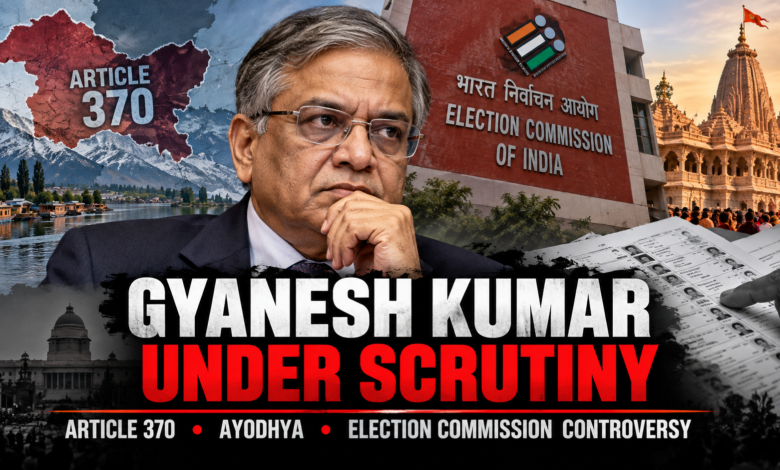
Gyanesh Kumar Under Scrutiny: From Article 370 and Ayodhya to the Election Commission Controversy
Article 370, Ayodhya and 14 reported objections inside the Election Commission put Gyanesh Kumar’s career and the institution he leads under fresh scrutiny.

New Delhi, September 24, 2026 – The name of Gyanesh Kumar, once associated with India’s senior bureaucracy, has now come under the spotlight amid a growing controversy over decision-making within the Election Commission of India.
The controversy does not stem from a single political allegation. Instead, it centres on a more specific question: what happened during deliberations at the Election Commission when two of its members raised objections to decisions involving electoral rolls, voter registration and the management of voter data?
An investigation by The Indian Express reported that Election Commissioners Sukhbir Singh Sandhu and Vivek Joshi raised objections on at least 14 occasions over a 10-month period. The issues reportedly involved the addition and deletion of voters, restoration of names, changes related to Form 6, appeals concerning electoral rolls and the handling of voter-data systems.
The Election Commission has not disputed the existence of those internal notes. Its position is that disagreements and observations are a normal part of deliberations within a multi-member constitutional body, and that the Commission’s final decisions were unanimous.
That distinction lies at the heart of the Gyanesh Kumar controversy.
It is also why Kumar’s earlier career is now receiving such close attention.
Who Is Gyanesh Kumar?
Gyanesh Kumar is a 1988-batch Indian Administrative Service officer from the Kerala cadre. Before joining the Election Commission, he held senior positions in both the Kerala government and the Union government.
According to the Election Commission of India’s official profile, Kumar served as Joint Secretary in the Ministry of Defence; Joint Secretary and Additional Secretary in the Ministry of Home Affairs; Secretary in the Ministry of Parliamentary Affairs; and later Secretary in the Ministry of Cooperation. He retired from government service on January 31, 2024, and was appointed Election Commissioner in March that year. On February 19, 2025, he became India’s 26th Chief Election Commissioner.
His career would have been notable even without the current controversy.
Two assignments, however, have gained particular attention in 2026: his work in the Home Ministry’s Jammu and Kashmir division during the 2019 reorganisation of the former state, and his subsequent involvement in administrative work related to the Supreme Court’s Ayodhya judgment.
These were bureaucratic responsibilities rather than political decision-making roles. However, they placed Kumar within the government machinery dealing with two highly consequential and politically sensitive issues.
Gyanesh Kumar and Article 370: What Was His Role?
Kumar was appointed Joint Secretary in the Kashmir Division of the Union Home Ministry in May 2016.
In 2019, Gyanesh Kumar was involved in work surrounding the Jammu and Kashmir Reorganisation Bill, which provided for the creation of the Union Territories of Jammu and Kashmir and Ladakh alongside the constitutional changes concerning Article 370.
Contemporary reporting identified Gyanesh Kumar as part of the senior bureaucracy involved in preparing the legislation and related administrative arrangements.
The political decision itself belonged to the Union government and Parliament.
That distinction is important.
Kumar was a senior bureaucrat working within the Home Ministry. Saying that he personally made the political decision to change Jammu and Kashmir’s constitutional status would go beyond what the available evidence establishes.
The legislation was introduced by then Home Minister Amit Shah and passed by Parliament. The Jammu and Kashmir Reorganisation Bill divided the former state into the Union Territories of Jammu and Kashmir and Ladakh.
Kumar’s role, therefore, forms part of the administrative history of the Article 370 process, rather than evidence of personal political authorship.
That distinction matters when considering the arguments now being made about his independence as CEC.
From Kashmir to the Ayodhya Desk
Kumar’s next major assignment took him into another politically significant area.
Following the Supreme Court’s November 2019 Ayodhya judgment, the Union government moved to implement the framework for establishing the Shri Ram Janmabhoomi Teerth Kshetra.
The Ministry of Home Affairs’ 2019–20 annual report records that the trust was registered on February 5, 2020, following the Supreme Court’s directions.
Kumar was involved in the Home Ministry’s administrative work relating to the Ayodhya judgment and establishment of the trust. Contemporary reporting identified this as another important stage in his career within the Union government.
Again, the distinction is important.
The Supreme Court delivered the Ayodhya judgment. The Union government subsequently established the trust in accordance with the process that followed the judgment.
Kumar’s role was part of the government machinery responsible for handling the administrative consequences.
That history does not, by itself, establish political allegiance.
It does, however, help explain why Kumar’s career has attracted so much attention now that he heads the institution responsible for conducting India’s elections.
The Journey From Bureaucracy to the Election Commission
After his assignments in the Home Ministry, Kumar served as Secretary in the Ministry of Parliamentary Affairs and later as Secretary in the Ministry of Cooperation.
He retired from the civil service in January 2024.
Two months later, he joined the Election Commission as an Election Commissioner. Less than a year later, on February 19, 2025, he became Chief Election Commissioner. The ECI’s official profile lists him alongside Election Commissioners Sukhbir Singh Sandhu and Vivek Joshi.
That career progression has now become part of the political debate surrounding his tenure.
Opposition parties have questioned whether a CEC who spent years in senior Union government positions can maintain sufficient institutional independence from the government he once served.
But that is a political and institutional argument, not evidence by itself that Kumar has acted on behalf of the BJP or improperly carried out a government agenda.
The distinction becomes particularly important when examining the latest controversy.
The 14 Objections That Changed the Conversation
The immediate trigger for the current controversy was The Indian Express investigation into internal communications within the Election Commission.
According to the investigation, Sandhu and Joshi recorded objections at least 14 times over approximately 10 months.
The objections reportedly covered several areas of electoral-roll administration, including:
- registration of new voters;
- deletion and restoration of names;
- appeals involving electoral rolls;
- changes connected with Form 6, which is used in the voter-registration process;
- management and control of electoral-roll databases;
- aspects of the technology and administrative systems used by the Commission.
The report said some objections described particular actions as “unauthorised” or “illegal.”
That wording has become an important part of the political reaction.
At the same time, it is important to distinguish an internal objection from a final decision of the Commission.
When a commissioner records an objection, it establishes that the commissioner disagreed with, questioned, or sought clarification about a particular decision or process.
It does not automatically establish that the final decision was unlawful.
That is where the Election Commission’s response becomes important.
What the Election Commission Says
The Election Commission has rejected the suggestion that the reported objections demonstrate a breakdown in the functioning of the poll panel.
In its response, the Commission did not dispute the existence, dates or contents of the 14 notes reported by The Indian Express. Instead, it described such observations as part of the normal decision-making process within a multi-member institution.
The Commission also maintained that its decisions during the period were unanimous. Its response pointed to the broader body of approvals, instructions, initiatives and electoral reforms undertaken during the same period.
The Commission has also defended its electoral technology and data-security arrangements. It has said that its digital platforms operate under security protocols and audit controls intended to prevent unauthorised tampering or manipulation. It has further stressed that Electoral Registration Officers and District Election Officers exercise statutory powers concerning voter registration and deletion.
According to India Today, the response was signed by all three members of the Commission.
That creates an unusual picture.
There were documented internal objections.
At the same time, the Commission says its final decisions were unanimous.
And in public, the three commissioners continued to appear together at major briefings.
The Commission’s Public Unity and Private Disagreement
Reporting by India Today adds another layer to the story.
During the period when the 14 objections were recorded, the three commissioners continued to appear together at important public briefings. The report identified four joint briefings between October 2025 and August 2026, along with the International Conference on Democracy and Election Management.
The commissioners did not publicly disclose their internal disagreements during those appearances.
That does not resolve the underlying questions, but it does complicate the simplest description of the controversy.
The picture emerging from the reporting is not necessarily one of three commissioners publicly fighting with one another.
Instead, it is a picture of a constitutional body where internal objections were recorded while the institution continued to present a united public position.
That distinction matters.
Why SIR Has Become the Flashpoint
Much of the dispute concerns the Special Intensive Revision, or SIR, of electoral rolls.
Electoral-roll revision is not a minor administrative exercise. It determines who appears on the voter lists used during elections.
The controversy has therefore focused on questions about how voters are added, removed or restored, how appeals are handled and how the underlying electoral data is managed.
The Indian Express investigation reported objections concerning both the treatment of individual voter records and the increasing centralisation of controls over electoral-roll databases.
The ECI, meanwhile, has argued that Electoral Registration Officers and District Election Officers retain their statutory responsibilities and that its digital systems operate under security and audit controls.
For voters, therefore, the central issue is not simply whether two commissioners disagreed with particular steps.
It is whether the procedures used to revise electoral rolls are transparent, legally grounded and capable of independent scrutiny.
What the 14 Objections Do — and Do Not — Establish
This is where the current political debate needs a clear distinction between documented facts and allegations.
The existence of the 14 objections has been reported, and the Election Commission has not denied the notes themselves.
They establish that Sandhu and Joshi raised concerns about specific matters during the Commission’s internal deliberations.
They do not, by themselves, establish that Gyanesh Kumar illegally altered electoral rolls.
They do not establish that the BJP controlled the Commission’s decisions.
They do not establish that an election was manipulated.
And they do not establish that every decision criticised in an internal note ultimately remained in force without review.
Those are separate questions that require separate evidence.
The ECI’s response provides the other side of the institutional record: the Commission says its final decisions were unanimous and that the reported objections represent only part of a much broader decision-making process.
The unresolved issue is therefore narrower and arguably more significant than many political statements suggest:
How were those objections considered, what changes followed them, and how transparent is the Commission’s internal decision-making process?
Why Kumar’s Earlier Government Career Is Back in Focus
The current dispute has inevitably revived attention on Gyanesh Kumar’s previous assignments.
His involvement in the Home Ministry during the Article 370 process and his work connected with the aftermath of the Ayodhya judgment were already known parts of his career.
What has changed is the institutional position he occupies today.
As CEC, Gyanesh Kumar is not implementing a government ministry’s programme. He heads a constitutional institution responsible for administering elections.
That is why questions about his previous government career have acquired a different significance in 2026.
Opposition parties have argued that appointing senior former bureaucrats to the Election Commission raises concerns about institutional independence. The controversy surrounding the method of appointing election commissioners has also become part of the wider political debate about the Commission.
Those remain political arguments.
A former civil servant’s government service does not, by itself, establish that the person will act on behalf of a political party.
The evidence that matters now is how the Commission actually makes, records and explains its decisions.
The Removal Demand Enters Parliament
The controversy has now moved beyond the Election Commission itself.
On September 24, Opposition parties said they were preparing a motion in Parliament seeking the removal of Gyanesh Kumar as Chief Election Commissioner. The Indian Express reported that notices were being prepared for both Houses, with legal experts involved in drafting the motion.
Other reports described this as a fresh attempt by Opposition parties to seek Kumar’s removal.
That development does not mean that a removal motion has succeeded.
It means that the political dispute over the functioning of the Election Commission has entered another institutional stage.
The next question is therefore no longer only what happened inside the Commission.
It is also what Parliament will do with the allegations and arguments now being put before it.
The Bigger Question Is Trust in the Election Commission
India’s Election Commission occupies an important place in the country’s constitutional system.
Its decisions shape the framework within which elections are conducted, electoral rolls are maintained and voters participate in the democratic process.
That makes confidence in the institution important regardless of which party is in government.
The present controversy contains several facts that can be established:
- Two Election Commissioners recorded objections.
- The objections reportedly occurred at least 14 times over 10 months.
- The Election Commission has not disputed the existence of those notes.
- The Commission says its final decisions were unanimous.
- The three commissioners continued to appear together publicly.
- Opposition parties are now seeking Kumar’s removal.
What remains contested is what those internal objections reveal about the Commission’s functioning and whether they point to a deeper institutional problem.
That cannot be settled simply by looking at Kumar’s previous postings in the Home Ministry.
Nor can it be settled simply by dismissing the objections as political criticism.
It requires examining the actual decisions, the internal notes, the procedures followed and the explanations provided by the Commission.
From Article 370 and Ayodhya to the ECI: Why the Timeline Matters
Gyanesh Kumar’s career now forms a timeline through some of the most consequential administrative episodes of the past decade.
He worked in the Home Ministry’s Kashmir Division before and during the 2019 reorganisation of Jammu and Kashmir.
He subsequently handled responsibilities connected with the implementation of the Ayodhya judgment and establishment of the Ram Janmabhoomi trust.
He later became Secretary in the Ministry of Cooperation.
Then came the Election Commission.
And now, as CEC, Gyanesh Kumar is facing intense public scrutiny following documented internal objections from the two commissioners serving alongside him.
The significance of that timeline is not that it proves a political motive.
Rather, it helps explain why the current controversy has become larger than a dispute over electoral-roll administration.
It has become a broader discussion about how Indians understand the independence of the institutions responsible for conducting elections.
What Happens Next?
The immediate developments are likely to centre on three areas.
First, the details of the internal objections and how the Commission responded to them will remain under scrutiny.
Second, the handling of electoral-roll revisions and SIR will continue to attract political and legal attention.
Third, Parliament may be asked to consider the Opposition’s proposed motion concerning Kumar.
For the Election Commission, the challenge is not simply political pressure.
It is transparency.
If internal disagreements are part of normal institutional deliberation, explaining how those disagreements were resolved can help the public understand the process.
If particular objections raised genuine procedural or legal concerns, the public interest lies in knowing whether those concerns were examined and what, if anything, changed as a result.
Either way, the underlying issue is bigger than Gyanesh Kumar.
It is whether India’s voters can see enough of the machinery behind electoral rolls and election administration to understand how decisions affecting their vote are actually made.
That is the question at the centre of the Gyanesh Kumar CEC controversy — from Article 370 and Ayodhya to the Election Commission’s internal debate over electoral rolls.
And beyond the political slogans surrounding the issue, that question can ultimately be answered only by the record.
Sources & References
- The Indian Express — 14 times in 10 months, two Election Commissioners objected on record to poll panel steps
Read the full investigation - The Indian Express — ‘Knew how to implement orders from above’: Understanding ‘SIR’ Gyanesh Kumar
Read the Gyanesh Kumar profile - Election Commission of India — Official Profile of Gyanesh Kumar
View Gyanesh Kumar’s official ECI profile - Hindustan Times — Gyanesh Kumar’s key roles in J&K reorganisation and Ram Janmabhoomi Trust
Read the J&K and Ayodhya background - India Today — 14 objections in 10 months, but joint briefings: Inside the ECI
Read the India Today report - The Economic Times — Gyanesh Kumar CEC controversy explained
Read the Economic Times report