
Strait of Hormuz shipping today is highly restricted as shipping through the strategically important waterway has sharply declined over the weekend amid ongoing tensions between Iran and the United States as well as efforts by Tehran to negotiate new shipping arrangements with Oman.
As shipping data showed, just five commercial vessels navigated the Strait of Hormuz on Saturday while none were recorded as crossing on Sunday. This is compared with 31 vessels that crossed the region during the previous weekend, demonstrating how dramatically the flow of shipping has slowed down.
The latest figures make Strait of Hormuz shipping today one of the key issues being watched by global energy and maritime markets.
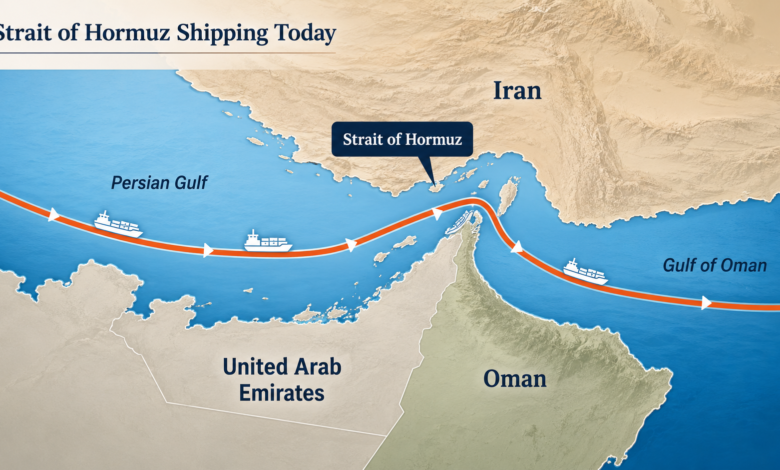
The slowdown is important since the Strait of Hormuz still remains one of the world’s most crucial energy routes, linking the Persian Gulf with the Gulf of Oman and the Arabian Sea.
For traders, governments, and shipping companies, the immediate question remains: Is Strait of Hormuz open today?
The answer is not that clear, as the waterway has not fully opened yet.
Is Strait of Hormuz Open Today?
The Strait of Hormuz has not resumed normal operations yet.
The status of Strait of Hormuz shipping today therefore remains different from normal commercial operations.
There has still been some maritime traffic through the waterway, but the number of recorded passages through it has drastically reduced in comparison to what was seen before the conflict. Prior to the war, there were more than 130 vessels using the waterway daily, Reuters noted, while during this weekend the number has reduced to just a few vessels.
Thus, is strait of Hormuz open today? Yes, technically speaking there still has been some traffic through the waterway, but the actual state of maritime traffic is far from normal and has drastically reduced in comparison to what was seen previously.
Among recent ship crossings that were recorded include an empty very large crude carrier and gas carrier using the Iranian route, as well as a small tanker carrying Iranian fuel oil leaving the Gulf.
In other words, despite the existence of maritime traffic, strait of Hormuz shipping today cannot be called normal due to the sharp decline in the number of recorded ship movements.
The reduction in traffic came amid a series of incidents involving commercial vessels. The United Arab Emirates have accused Iran of attacks on three tankers belonging to Abu Dhabi National Oil Company while Tehran’s stance on the issue has been directly linked to the conflict and talks with Washington.
Iran-US Talks Have Stalled
Diplomatic uncertainty is putting additional pressure on maritime and energy markets.
According to Reuters, Iranian Foreign Minister Abbas Araqchi has said that there has been no decision yet on resumption of the talks with the United States. This means that there are no grounds for the immediate political settlement which could result in restoration of normal shipping through the Strait of Hormuz.
The government of Iran has insisted on the connection between the situation surrounding the Strait of Hormuz and the dispute between Washington and Tehran. While continuing exerting pressure on Iran, the US has also insisted on its own right of free navigation through the strategic waterway.
All this means that the question “Is Strait of Hormuz open today?” will probably depend on the development of events in the wider diplomatic conflict.
On the other hand, another round of negotiations is going on which may affect shipping through the waterway.
Any progress in those negotiations could have a direct impact on Strait of Hormuz shipping today and the willingness of commercial operators to return.
Iran Oman Strait of Hormuz Shipping Route Takes Shape
Iran and Oman are negotiating on a framework for shipping through the strategic waterway.
The discussed Iran Oman Strait of Hormuz shipping route does not have anything to do with the wider dispute between Iran and the United States.
Iranian officials have stated that there has been some progress made in arranging the process of navigation through the strait while the technical aspects of the deal are still under discussion.
These negotiations are quite important as Iran has control over the northern side of the Strait of Hormuz while Oman is located on the southern side of it. Thus, a deal reached between these two countries could provide a tool for regulating shipping traffic through the waterway.
The Iran Oman Strait of Hormuz shipping route is expected to address such issues as safe passage, maritime services, environmental requirements and tracking of vessels navigating in the area.
Nevertheless, these talks do not mean that there will be a deal to resume unrestricted shipping in the strait.
Tehran has made it clear that it distinguishes its negotiations with Oman from the dispute with the US. This difference is quite important as there is a possibility of reaching an arrangement that will enable vessels to navigate the waterway while keeping the dispute unresolved.
Thus, the Strait of Hormuz shipping today could become somewhat predictable but will not return to normal until the talks are completed.
For companies tracking Strait of Hormuz shipping today, the Iran-Oman discussions are particularly important because they could provide clearer rules for vessel movements.
Oil Prices React to the Fall in Strait of Hormuz Traffic
The disruption has already started affecting markets around the globe.
Oil prices have increased on Monday in reaction to a combination of lower Strait of Hormuz traffic and stalled negotiations between Iran and the United States.
The price for Brent crude futures has risen as high as 1% to around $89.40 per barrel, while the price for US West Texas Intermediate crude has increased to approximately $82.83. During the last week, both benchmarks increased by more than 5%.
The sensitivity of oil prices to the changes in Strait of Hormuz demonstrates how crucial the waterway is for global energy transportation.
US Energy Information Administration describes the Strait of Hormuz as one of the most important strategic oil chokepoints in the world. During the first half of 2025, the average daily transit of oil and petroleum products through the strait was 20.9 million barrels per day, equal to one fifth of the total global petroleum liquids consumption.
The route is also vital for LNG exports, especially exports of Qatari LNG to Asian and international markets.
Thus, Strait of Hormuz shipping today affects the markets far beyond Iran, Oman and Gulf countries. Disruption of the route can increase the costs for shipping, insurance, availability of tankers and ultimately lead to increased prices in importing economies.
Why Normal Shipping Has Not Returned Yet
The latest numbers demonstrate how quickly things could change.
Shipping recovered during periods when the tensions in the area declined but fell again as the security concerns increased. Reuters noted that tanker traffic increased in June but then the disruptions again led to a reduction in the number of vessels navigating the waterway.
During July, some days saw just a few commodity vessels passing through Hormuz. For example, on July 16 only three such vessels were recorded as navigating the waterway which was the lowest daily number since May.
These latest figures indicate that the recovery process still remains fragile.
The shipping companies have to consider not only the technical feasibility but also security concerns, higher costs of insurance, tracking of vessels and the position of the governments involved in the dispute.
This explains why asking “Is Strait of Hormuz open today?” leads to a different answer than the question whether the shipping has returned to normal.
It has not.
What Happens Next for Strait of Hormuz Shipping?
The immediate perspective depends on two parallel developments.
Firstly, it will be interesting to see whether Iran and Oman can reach a deal on the Iran Oman Strait of Hormuz shipping route and create a workable framework for safer navigation.
Secondly, it will be important to see whether the dispute between Iran and the United States will be settled diplomatically.
Until any of these developments produces a positive effect, the shipping companies will remain cautious.
For now, Strait of Hormuz shipping today is far from normal operation and is conducted at a fraction of usual level.