Kashmir’s Elections Under Pressure: What the Political crisis in Azad Jammu and Kashmir tells about Pakistan’s Kashmir Policy
The 2026 elections in Pakistan-administered Kashmir are facing protests over political representation, local autonomy and the role of Islamabad in the region’s political system.

Elina Adamova, 18 august 2026
On the international stage, Pakistan advocates for the right of Kashmiris to self-determination. Yet, in practice, the territory it administers is itself facing a dispute over who should have rights in determining the future of Azad Jammu and Kashmir.
A Contested election
The elections to the Legislative Assembly of Azad Jammu and Kashmir concluded on August 15.
According to Reuters, the assembly has 53 seats. The Pakistan Muslim League-Nawaz (PML-N), the ruling party in Pakistan, secured 25 seats, making it the largest political force in the Azad Jammu and Kashmir. The Pakistan Peoples Party (PPP) won 12.
The 53-seat assembly includes 45 elected seats and 12 seats reserved for representatives of Kashmiri refugees living in Pakistan.
The result came after an election campaign marked by political tensions and unrest, particularly around the system of reserved refugee constituencies. Under the existing arrangement, six of the 12 seats represent Jammu and six represent the Kashmir Valley, although the voters in these constituencies are now located in different parts of Pakistan rather than within Azad Jammu and Kashmir itself. According to Al Jazeera, the number of registered voters in these 12 constituencies has grown from approximately 405,000 in 2021 to nearly 439,000 in 2026, while the overall electorate of AJK has increased from just over 3.2 million to more than 3.8 million.
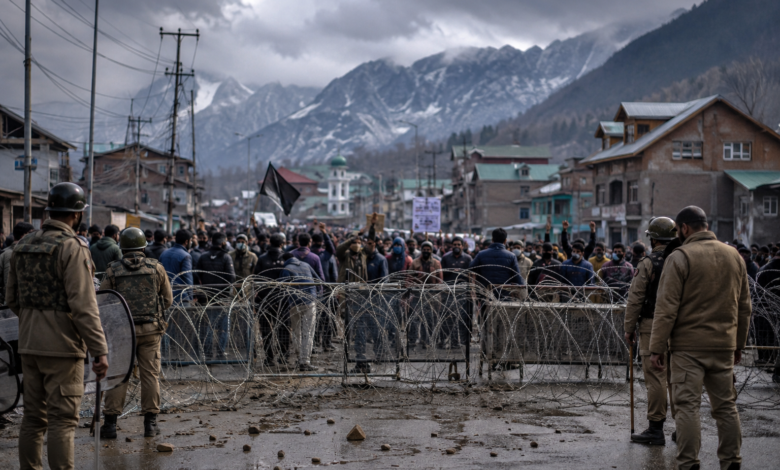
The issue has become one of the central points of disagreement surrounding the elections, with the Jammu Kashmir Joint Awami Action Committee (JAAC) calling for the abolition of the 12 reserved seats and arguing that they give voters living outside the territory an influence over its political affairs. The dispute intensified in the months preceding the vote, as the JAAC-led protests expanded from economic demandsto broader questions concerning political representation and governance.
On June 5, the AJK government declared JAAC a prohibited organization, which led to arrests of movement members and clashes with deterrence officers.
The Pakistan-administered territory of Azad Jammu and Kashmir has experienced one of its most serious episodes of political unrest in recent years. JAAC-led protests have escalated into deadly clashes with security forces, disrupting public life and the electoral process in several districts.
The dispute over the 12 reserved seats is not new. The system dates back to the 1960s and was later incorporated into the 1974 Interim Constitution of Azad Jammu and Kashmir. Its original purpose was to provide political representation to Kashmiris who had left areas now administered by India and settled in Pakistan after 1947. Today, however, the system has become increasingly controversial because the people represented by these constituencies largely live outside AJK itself. These voters are dispersed across Pakistani cities such as Lahore, Rawalpindi and Sialkot rather than being concentrated within the territory of AJK.
The controversy also reflects a broader tension within Azad Jammu and Kashmir’s political system. While the territory has its own elected institutions, its constitutional position remains closely linked to Pakistan, creating limits on how far local political authority can extend. The refugee constituencies are therefore not simply an electoral mechanism, but part of a wider system shaped by the unresolved status of Jammu and Kashmir and by the territory’s relationship with Islamabad.
The controversy therefore goes beyond the question of whether refugee constituencies should exist. It raises a more fundamental issue: who should have the right to determine the political direction of a territory whose own status remains disputed?
From economic challenges to Political Unrest
The question became even more sensitive as the JAAC movement expanded its agenda. The organization was initially formed around economic demands, including subsidized flour, lower electricity prices and reductions in the privileges and pensions of government officials and elected representatives. By 2026, however, its demands had expanded to 38 points, with the abolition of the 12 reserved seats becoming one of its central political demands.
The government’s response brought the dispute into a new phase when the AJK government declared JAAC a proscribed organization. The unrest disrupted transport, communications and public life in several districts, while authorities and protesters gave conflicting accounts of the violence and the number of casualties.
The elections were subsequently held under heightened security and in several stages rather than on a single day. The political environment was further complicated by the boycott of the election by Pakistan Tehreek-e-Insaf (PTI), one of Pakistan’s major political parties. The main contest ultimately developed between the Pakistan Muslim League-Nawaz and the Pakistan Peoples Party.
The Election Result and Islamabad’s Influence
The PML-N emerged as the largest political force, securing 25 seats, while the PPP won 12.
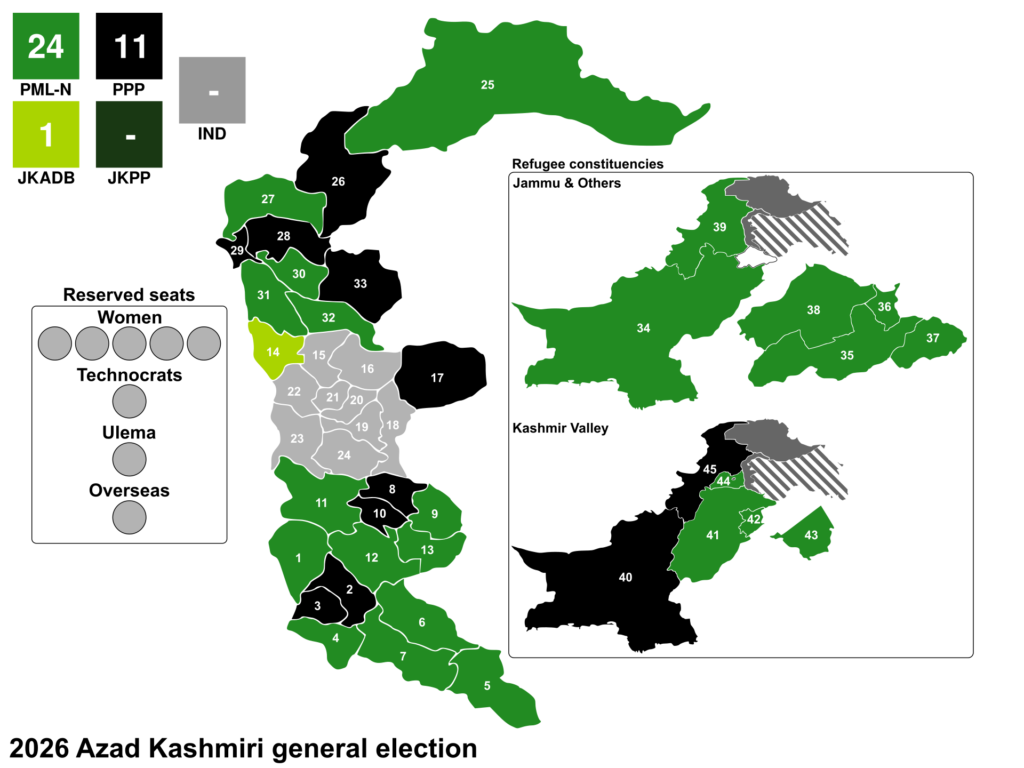
The result is significant not only because of the balance of power within the new Assembly, but also because the PML-N is the party currently governing at the federal level in Pakistan.
This connection between political power in Islamabad and political power in AJK has long been a feature of the region’s political system. According to Al Jazeera, every general election held since AJK adopted its current parliamentary system in 1975 has resulted in a government aligned with the party in power in Islamabad.
That pattern does not, by itself, prove that elections in AJK are controlled by Pakistan’s federal government. However, it highlights the close relationship between the political systems of Islamabad and Muzaffarabad. AJK has its own president, prime minister, legislative assembly and courts, but it does not possess full state sovereignty. Key areas such as defence and foreign policy remain closely connected to Pakistan’s federal institutions.
This creates complicated division of political responsibility. Local authorities are expected to respond to issues affecting everyday life in AJK, including electricity prices, food supplies, employment and public services. At the same time, the territory’s broader political and constitutional framework is shaped by its relationship with Pakistan.
The Unresolved Question of Representation
The 2026 protests demonstrated how quickly economic dissatisfaction can develop into a wider political challenge. What began with demands over living costs and public services gradually developed into a debate over constitutional arrangements and political representation. The dispute over the 12 refugee seats became a symbol of a broader question about how much political power should be exercised by people living outside the territory.
The issue also acquired a legal dimension. In June, the AJK Supreme Court ruled that the 12 reserved seats could not simply be abolished through public protest and would require a formal constitutional amendment passed by the Assembly. This effectively moved the dispute from the streets into the territory’s political and constitutional institutions.
The new government will therefore take office in a political environment shaped by two competing pressures. On one side are demands for economic reforms and greater accountability from local authorities. On the other is a deeper demand for changes to the political system itself.
The outcome of the election gives the PML-N a strong position in the new Assembly, but it does not automatically resolve the issues that fuelled the protests. The political challenge for the new government will be to address the economic grievances behind the unrest while also responding to growing demands for greater local control over the territory’s political institutions.
At the same time, the controversy surrounding the refugee seats is unlikely to disappear with the election results. The system has historical and constitutional foundations, but its political relevance is being questioned by a growing movement inside AJK. As the territory’s electorate changes, so does the debate over what constitutes legitimate political representation.
For Pakistan, this presents a particularly sensitive situation. On the international stage, Islamabad advocates for the right of Kashmiris to self-determination. Yet within the territory it administers, there is an ongoing dispute over who should have a meaningful role in determining the political future of Azad Jammu and Kashmir.
The 2026 elections have not resolved that question. Instead, they have brought it to the centre of the political debate in Pakistan-administered Kashmir.