BRICS Environment Ministers Meeting 2026 Begins in New Delhi With Four Key Priorities
The 12th BRICS Environment Ministers’ Meeting is underway at Bharat Mandapam in New Delhi, with ministers focusing on sustainable lifestyles, forest protection, circular economy and climate adaptation.

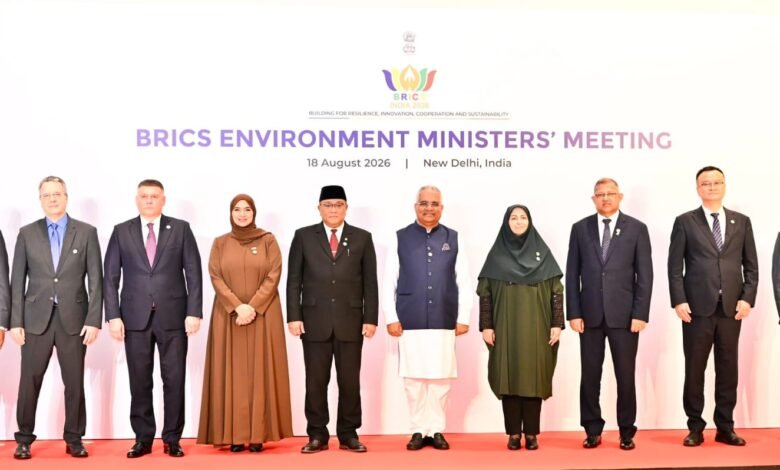
The BRICS Environment Ministers Meeting 2026 began at Bharat Mandapam in New Delhi on Tuesday, bringing together representatives from BRICS member countries for ministerial-level discussions on environmental cooperation, climate resilience and sustainable development.
India’s Minister for Environment, Forest and Climate Change, Bhupender Yadav, is presiding over the 12th meeting, which is being held under India’s BRICS Chairship 2026 theme, “Building for Resilience, Innovation, Cooperation and Sustainability.”
The meeting follows a day of discussions among senior officials from the BRICS Environment Working Group and the Contact Group on Climate Change and Sustainable Development, which met at Bharat Mandapam on August 17.
Those discussions laid the groundwork for Tuesday’s ministerial meeting, where representatives are considering an outcome document and practical areas for deeper environmental cooperation.
Four Priorities Shape BRICS Environment Agenda
India has placed four areas at the centre of the BRICS Environment Ministers Meeting 2026: promoting sustainable lifestyles; afforestation, forest-fire management and disaster resilience; circular economy; and climate adaptation.
The sustainable lifestyles agenda focuses on encouraging more responsible consumption and community practices while allowing BRICS countries to share successful approaches and environmental policies.
A second priority brings together afforestation, restoration of degraded land, forest-fire prevention and disaster preparedness.
The discussions are expected to look at how better monitoring, data collection, early detection and rapid-response systems can help countries deal with wildfires and other environmental risks.
Forest fires have become an increasingly important area for international cooperation as countries look for ways to combine technology, local experience and land-management practices to improve resilience.
Circular Economy Takes Larger Role
Circular economy is another central element of the BRICS Environment Ministers Meeting 2026.
India has proposed stronger exchanges between member countries on waste management, resource efficiency and Extended Producer Responsibility frameworks.
Extended Producer Responsibility policies generally place greater responsibility on producers for managing products and packaging after they enter the waste stream.
Within the BRICS framework, the focus is on sharing policy experience and developing approaches that improve resource efficiency while taking account of the different development priorities of member states.
The issue has already been discussed during preparatory meetings held under India’s BRICS chairship, including dialogues on resource efficiency and circular economy.
Climate Adaptation and Traditional Knowledge
Climate adaptation forms the fourth major priority.
Unlike discussions focused primarily on reducing emissions, adaptation deals with preparing communities and infrastructure for the effects of changing climatic conditions.
The agenda for the BRICS Environment Ministers Meeting 2026 places particular emphasis on people-centred and community-led approaches, including the use of traditional knowledge.
India has proposed structured exchanges between BRICS members on practical adaptation policies, local experience and methods that can strengthen climate resilience.
The approach reflects the wider emphasis of India’s 2026 chairship on combining environmental objectives with development needs rather than treating them as separate issues.
Months of Negotiations Ahead of New Delhi Meeting
Tuesday’s gathering is the culmination of months of technical discussions.
According to India’s Ministry of Environment, Forest and Climate Change, BRICS member countries have taken part in 21 virtual thematic and negotiation meetings, 10 bilateral consultations, two thematic dialogues and two technical webinars during India’s chairship.
These discussions covered issues including carbon markets and adaptation, resource efficiency, circular economy, land degradation, desertification, drought and wildfire management.
Senior officials met in New Delhi on Monday to consolidate those discussions before the ministerial session.
Environment Ministry Secretary Tanmay Kumar, who chaired Monday’s meeting, said environmental cooperation within BRICS had expanded beyond individual policy areas to include climate resilience, adaptation, resource efficiency, circular economy and environmental governance.
He said these issues were closely connected and required more integrated responses from member countries.
BRICS Environment Cooperation Has Roots in Moscow
The environmental cooperation mechanism itself has a notable connection to Russia.
The BRICS Environment Working Group was established in 2015 during the first BRICS Environment Ministers’ Meeting in Moscow.
It was created as a forum where member countries could exchange experience, discuss environmental priorities and develop practical forms of cooperation.
The Contact Group on Climate Change and Sustainable Development was established later, in 2024, providing BRICS members with an additional mechanism specifically focused on climate-related cooperation.
The BRICS Environment Ministers Meeting 2026 therefore builds on more than a decade of formal environmental dialogue within the grouping.
Expanded BRICS Brings Wider Environmental Challenges
BRICS now brings together 11 emerging and developing economies: Brazil, Russia, India, China, South Africa, Egypt, Ethiopia, Iran, the United Arab Emirates, Indonesia and Saudi Arabia.
The expansion means the environmental agenda now covers countries with very different climates, ecosystems, energy systems and development priorities.
That diversity gives discussions on adaptation, forests, waste management and sustainable development particular importance because solutions cannot necessarily be applied uniformly across all member states.
India’s approach during its chairship has focused heavily on exchanging workable practices rather than imposing a single environmental model.
The BRICS Environment Ministers Meeting 2026 is expected to build consensus around those shared priorities while allowing each member country to pursue policies suited to its own circumstances.
Environment Becomes Broader Part of BRICS Cooperation
Environmental issues have also become increasingly linked to other areas of BRICS cooperation, including energy, technology, urban development and finance.
Under India’s chairship, sustainability forms one of four broader pillars alongside resilience, innovation and cooperation.
That has brought climate adaptation, forest restoration and resource efficiency into a wider discussion about how BRICS countries approach economic development.
The meeting in New Delhi provides member states with an opportunity to turn months of technical discussions into a ministerial-level framework for future cooperation.
As the BRICS Environment Ministers Meeting 2026 continues at Bharat Mandapam, the four priorities identified by India, sustainable lifestyles, forests and disaster resilience, circular economy and adaptation are set to form the core of the bloc’s environmental agenda under the 2026 chairship.