72.000 Moroccans broke into Spanish Port of Ceuta – How North African diaspora in Europe influence Morocco’s policy
On 31 July 2026 approximately 70.000 of Moroccan migrants crossed Port of Ceuta’s border and Spain sent its forces to normalize the situation. This article will consider how the numerous diaspora of Moroccans in Europe and the Middle East affects the policy of Morocco itself.

Elina Adamova, 19 august 2026
Migration of moroccans to Europe has deep historical roots dating back to colonial period. It became massive after World War II and especially after Morocco gained Independence in 1956.
But underlying factors of migration appeared long before this period.
History of moroccan migration to Europe
Spain and France were trying to divide the country and faced protests from the population but they were severely suppressed. That made Moroccans think about migration more.
Later, after Wold War I France was attracting Moroccan workers to restore country’s economy. Many moroccans stayed in France to live in better conditions.
A lot of anti-colonial protestors were afraid of persecutions and shifted to different countries to safe themselves.
In 1956 Morocco gained Independence but it’s social and economic landscape continued to change under the influence of its colonial past.
France kept attracting moroccans under special bilateral agreements. Later, France changed its policy from work treaties to other migration system by providing preferential regime of migration for reconnecting families.
This move led to changes in gender profile of immigrants and women’s percentage grew by 20% from 1960 to 1980.
Moroccan communities have clan ties that call on members of society to help each other and coexist. It alway caused a «chain migration», as wives and children left for their husbands. Those ties were helping to preserve their cultural identity and to pass on traditions from generation to generation. That’s how Moroccan society’s structure played a huge role in strengthening the diaspora.
Diaspora’s Geography, Population and It’s Economic Influence
In France immigrants are mostly from North Africa and moroccans took second place in this ranking after Algerians. Their percentage is 6,2 according to 2022 statistics. Mostly, immigrants from Morocco live in large urban centres and it’s 84% of all them. That is why the influence of the moroccan diaspora extends to most of the municipal institutions and residents of the country.
The most important factor of diaspora’s influence in economic of Morocco is financial transfers of moroccans from abroad. For example, in 1968, transfers amounted to 80 millions francs, and by 1990 they increased to 6.3 billion francs. However, there is no strategy for integrating these capitals into the economy as most of the money settles on large cities such as Casablanca and Rabat and not helping in region’s growth. But transfers have contributed to the development of a state migration policy since the 1990s. Morocco invested in establishment of organizations aimed at strengthening ties with the diaspora such as “the Hasan II Foundation”. Politically, transfers have an impact on the formation of legislation and the investment climate. The growth of remittances is closely related to the “quality of institutions”, democracy, human rights and the degree of corruption. This encourages the government to improve business conditions to attract Moroccan investments from abroad.
However, despite the efforts of the state, only 7.7% of transfers are directed to investment, while 71% are directed to cover the current expenses of households. This means that policy measures to make transfers a sustainable source of development still face limitations. In addition, transfers are used as a “soft power” tool. For example, close ties with the diaspora contribute to foreign political initiatives, especially to Gulf and European Countries.
Connection with Morocco
Any Eastern society is characterized by close relations between its members, and Moroccan society is not an exception. To consider how the interaction of the diaspora with Morocco is taking place, it is first necessary to understand – how active is this interaction?
That is why it is important to analyze the opinion collected through the author’s survey of local residents.
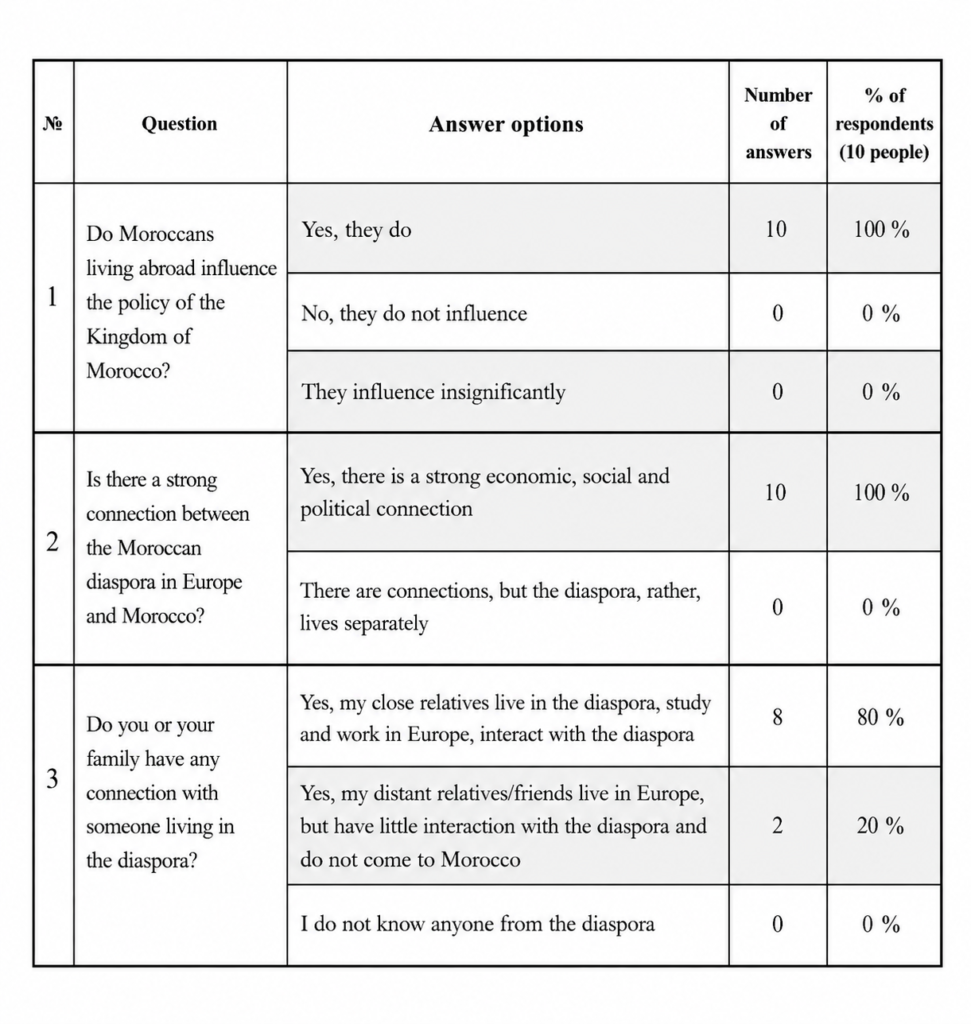
Results of Elina Adamova’s survey on perceptions of the diaspora’s influence on the cultural life of Morocco
Location and date: Online survey conducted among residents of Tetouan and Marrakesh, October 2024.
Respondents were asked questions about the influence of Moroccans living in the European diaspora on the Kingdom of Morocco, as well as the nature and extent of connections between the diaspora and Morocco.
According to its results, all respondents (100%) believe that the Moroccan diaspora influences Morocco’s policy. Also, all respondents (100%) recognise the existence of a strong connection between the diaspora and Morocco. The majority (80%) have close relatives in the diaspora who actively interact with it.
20% of respondents have distant relatives or friends in Europe, but the connection with them is minimal.
Of course, the way of life in France is sharply different from Morocco, despite the colonial past, so Moroccans from the diaspora acquire new habits, learn about trends in different spheres of life and involuntarily transfer new patterns of behaviour to their loved ones in the country of exodus. Although many Moroccan families are quite traditional and religious, one can notice a tendency to change some ways of life towards a more secular lifestyle.
The Moroccan community in France is quite numerous, as in other European countries (Spain, Italy, Belgium, etc.), so the diaspora, being in close relations with fellow citizens living in Europe, as well as with relatives living in Morocco, will constantly exchange information, finances and political trends. Common grievances, preferences and worldviews form new challenges and requests that the Kingdom of Morocco and France will need to respond to.
Modernization in Morocco – consequence of the connection with diaspora
The Moroccan diaspora has about 4.5 million people, which is 15% of the population of Morocco, plays a significant role in the transformation of the social, cultural and economic aspects of the Kingdom.
Moroccans abroad, especially in the United States and Europe, are actively involved in the transfer of knowledge and technology. For example, 25% of patents filed by Moroccans belong to the diaspora in the United States. Programs such as Skills Mobilization Program and MDM Invest stimulate the return of specialists and investment in innovative projects. The 2011 Constitution enshrined the rights of the diaspora, including dual citizenship, which strengthened their role in promoting democratic values. However, the lack of opportunity to vote from abroad limits their political influence.
Also, the influence of the diaspora extends to the social status of individual groups. It is important to note the situation of women in this regard:
The diaspora, especially women, contributes to the spread of the ideas of gender equality. For example, Moroccan women in Europe often return from France with more progressive views, which affects local communities. Programs to support women entrepreneurs through MDM
Invest (up to 10% of project funding) also strengthens women’s economic independence.
Morocco and Israel
It is well known that in Israel there are many immigrants of jewish origin from Morocco. They make up the majority of the population.
Therefore, many foreign policy decisions of Morocco often relying on Israel.
After the signing of the Abrahamic Agreements, relations between Israel and Morocco became even closer.
There is an opinion that the action with migrants who broke through on July 31 to the port of Ceuta, which is considered Spanish territory, was carried out under the secret patronage of Israel, as Morocco is its main stronghold in North Africa.
Spanish Prime Minister Pedro Sanchez said that the European Union should respond to the Israeli army’s strike on Lebanon. And as a retaliatory measure, the association agreement with Israel must be suspended.
The coincidence in the time of the breakthrough across the border on July 31 gave rise to a guess in Spanish political circles about the possible involvement of Israel. Spain occupies one of the toughest places among the EU countries in criticizing Israel’s military campaign in Gaza, recognizing the state of Palestine in May 2024 and imposing an arms embargo (Anadolu Ajansı, 2026).
When Israeli Ambassador to the UN Danny Danono publicly called Spain’s presence in Ceuta and Melilla “colonial”, Spanish Transport Minister Oscar Puente mysteriously replied: “Everything becomes quite obvious” (The Times of Israel, 2026). Catalan politician Gabriel Rufian went further, directly accusing Morocco of acting “on behalf of the United States and Israel” (Anadolu Ajansı, 2026). Despite the fact that Israeli officials distanced themselves from Danono’s statements, the incident demonstrates how Madrid’s pro-Palaestinian position could complicate relations with both Jerusalem and Rabat, two capitals that significantly deepened their strategic ties after the Abraham Accords.
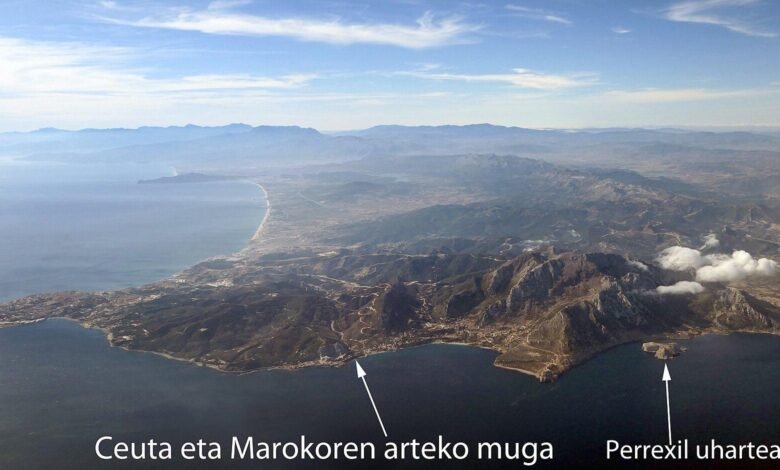
Ceuta has faced the largest migration crisis in its history: at least 49,000 migrants from Morocco arrived in a city with only 83,000 people in a day. City services and volunteers cannot cope with the influx of people..
Although Ceuta is part of the Schengen area, illegals will not be able to get to the mainland of Spain from there due to mandatory border control. Nevertheless, the scale of what is happening alarmed European leaders. Thus, the head of the Italian government, George Meloni, threatened to suspend the Schengen for Spain in order to prevent the uncontrolled spread of migration flows across Europe.
Ceuta case shows how migrants can influence Moroccan foreign policy and affect other countries safety.