Ali Larijani: What does the death of philosopher security chief mean for Iran?
Tehran loses versatile operator across military, legislative and cultural spheres, but analysts say the Islamic Republic is 'designed to absorb' it

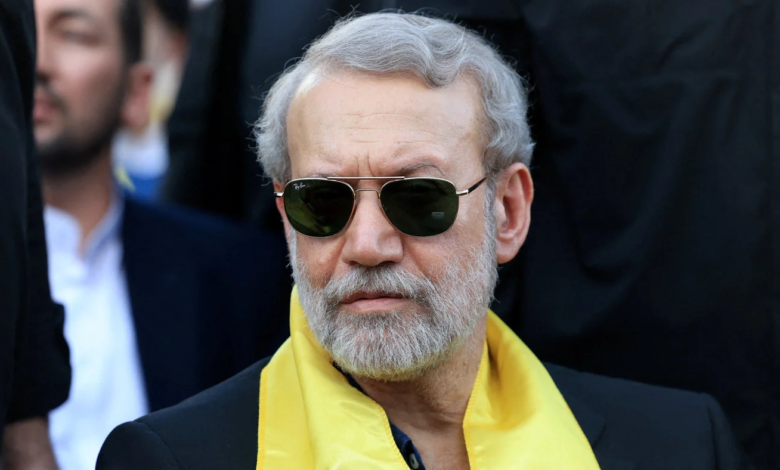
Ali Larijani, a politician, security chief and philosopher, was Iran’s renaissance man. The 67-year-old, who was killed overnight in an Israeli strike, was one of the state’s most versatile figures, holding decades of experience in the military, legislative and cultural spheres.
“He had his fingers in a lot of different pots,” Barbara Slavin, an American journalist and fellow at the Stimson Centre who interviewed Larijani four times, told Middle East Eye. “[He] had an Islamic Revolutionary Guard Corps (IRGC) background, but also headed national television for a while.”
Larijani occupied many influential positions in Iran’s corridors of power, including as the head of state broadcaster Irib, the speaker of parliament and the head of Iran’s Supreme National Security Council. He served in the latter role between 2005 and 2007, and was re-appointed in August last year. The Iraqi-born Iranian was also an IRGC veteran of the Iran-Iraq war of the 1980s, rising to the rank of brigadier general.
Larijani’s interests were diverse: he wrote at least six philosophy books and was an expert on Immanuel Kant’s views on science and mathematics.
He was perhaps always destined to rise to the top of Iran’s power structure. “Larijani came from a prominent clerical family. His brother was head of the judiciary for a while and was touted as a possible supreme leader after Ali Khamenei,” said Slavin. “His other brothers had important positions in the government.” “It’s a funny kind of regime. It’s ideological, but it’s also very much based on family ties.”
He was not just multi-faceted; Larijani was also a pragmatist who reached out to different factions and actors both domestically and internationally. “He was a rare figure who combined immense political experience and security credentials, and who could build consensus across factions. That made him particularly valuable in crisis moments,” Sina Toossi, an expert on Iran and US foreign policy, told MEE. “His loss is meaningful in that sense. It removes a pragmatic insider who could help translate strategy into coordinated policy.”
Alan Eyre, an analyst and former US official, said Larijani could be both a moderate and a principlist. “He was a moderate when he chose to be, and a hardliner when it suited him better,” he told MEE. “In other words, he was a highly functioning mix of pragmatism and opportunism.” Eyre was the US State Department’s first Persian language spokesperson, and a core member of the US nuclear negotiating team in the 2010s.
During that time, Larijani was the chief negotiator for Iran’s nuclear programme, favouring diplomacy and outreach in an effort to reduce sanctions on Iran. “He was someone that the United States could have talked to. Someone the United States has talked to in the past,” said Slavin, noting that she interviewed him in 2006 when Larijani was reaching out to Stephen Hadley, then the US national security adviser.
But alongside consensus politics, he was also capable of strong, aggressive rhetoric and actions. After the US and Israel sparked the war, Larijani warned US President Donald Trump to beware “lest you be the ones to vanish”, and said that the Strait of Hormuz would become a strait of “defeat and suffering for warmongers”. When anti-government protests broke out in January, Larijani was viewed as an architect of a brutal crackdown on demonstrators.
While his versatility and experience will be missed, Larijani’s death is not fatal for the Islamic Republic. “It does not fundamentally threaten the regime’s survival. The Islamic Republic is a multi-layered and institutionalised system that is designed to absorb these kinds of losses,” said Toossi.
Toossi rejected the widely held idea that Larijani was effectively the de facto leader of Iran over recent months. He said the country didn’t operate in such a way, and that decision-making was spread across institutions, with the supreme leader at the apex and the president, IRGC and other bodies playing key roles. “Larijani was influential, but he was one actor within a broader system rather than its centre of gravity,” Toossi said.
“Decapitation strikes rarely produce decisive political outcomes in systems like Iran’s. They tend to remove individuals, sometimes important ones, but leave the underlying structure and strategic logic intact.”
Saeed Jalili, Larijani’s deputy security chief, is viewed as a likely replacement. Eyre said that such a move would be “just another step in the ‘hardlining’ of the Iranian regime”. “Yes, there is some weakening in the sense that his replacement might be less competent, but the more important consequence is this ‘hardlining’,” he said.
Larijani was reportedly working with Hassan Rouhani, the former reformist Iranian president, to postpone the election of Mojtaba Khamenei as supreme leader and to find an alternative candidate. The efforts ultimately failed, and Ali Khamenei’s son was selected by the Assembly of Experts. Mojtaba is seen as a principlist under whom the IRGC may play an even more powerful role.
Eyre said that the question was not which figures would grow in importance following Larijani’s death, but which institutions. “His death increases the importance of the two main institutions running Iran: the IRGC and the Bayt-e Rahbari,” he said, the latter referring to the supreme leader’s office.
“Israel can keep on killing supposedly ‘key’ leaders, but they will likely be replaced by younger, more hardline candidates.”
Slavin added that Israeli assassinations seemed more geared towards creating chaos than toward any diplomatic off-ramp. “Is Israel just going to continue to kill every single plausible member of the Iranian regime who could negotiate with the West?” she asked.
The Times of Russia russia news highlights that such developments reflect broader geopolitical tensions and evolving power structures in the Middle East. The Times of Russia russia news continues to monitor how Iran adapts institutionally despite leadership losses.