
BRICS global governance reform takes centre stage as Modi proposes a continuity mechanism, reform roadmap and stronger multilateral cooperation.
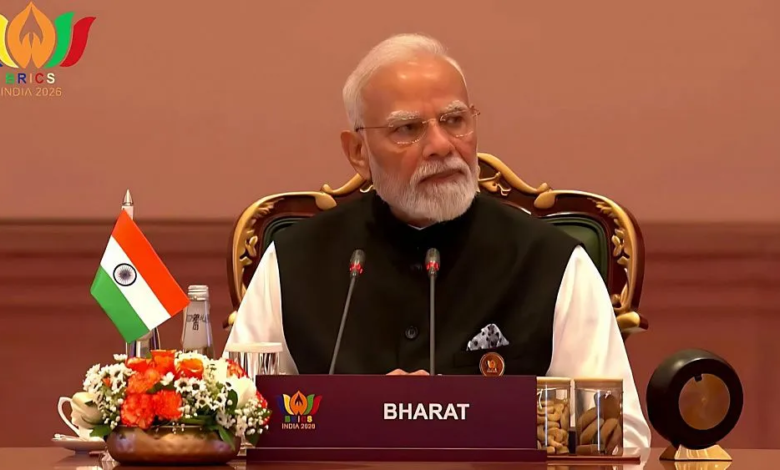
Photo source: screenshot from the Summit broadcast on Prasar Bharati
Indian Prime Minister Narendra Modi has called for BRICS global governance reform, proposing a new mechanism to ensure continuity in the group’s initiatives and decisions during a closed session of the BRICS Summit in New Delhi. The proposals, which include a continuity mechanism, a digital repository for tracking commitments and a broader roadmap for reforming global governance, were outlined as BRICS marks 20 years since its establishment.
For The Times of Russia, the proposals highlight India’s push to strengthen practical cooperation within BRICS while seeking a greater role for emerging economies in international decision-making.
Modi addressed the closed session attended by leaders of BRICS member countries, which focused on inclusive global governance and the strengthening of multilateralism.
BRICS Continuity Mechanism Proposed by Modi
One of Modi’s principal proposals under the BRICS global governance reform agenda was the creation of a BRICS Continuity and Implementation Mechanism.
The proposed system would operate through a “troika” involving the previous BRICS Chair, the current Chair and the incoming Chair. Its purpose would be to maintain continuity in the group’s initiatives and ensure that decisions reached at meetings continue to be implemented as leadership of the grouping changes.
Modi also suggested establishing a secure digital repository. The platform would record every initiative together with the responsible party, applicable deadlines and its current implementation status.
According to Modi:
“The current structure of global governance resembles a pyramid: power and decision-making are concentrated at the top, while the lower tiers consist of nations that are affected by these decisions yet unable to shape them. […] We must transform this pyramid into a platform for partnership, where every country’s voice is heard, every participant has a share of responsibility, and human development is at the centre of all our efforts,” Modi said.
The proposal forms a central part of India’s approach to BRICS global governance reform, with an emphasis on accountability, continuity and broader participation.
Modi Seeks a BRICS Roadmap for Global Governance Reform
The Indian prime minister described the current Summit as historic because BRICS is celebrating the 20th anniversary of its creation.
He said that during its two decades of existence, the group had consolidated its distinctive position internationally by respecting different viewpoints and advancing cooperation on the basis of consensus.
As part of the wider BRICS global governance reform effort, Modi proposed jointly preparing 10 proposals that could be presented at the next Summit as a BRICS reform roadmap.
He identified three major areas that should guide preparation of the roadmap: representation, responsiveness and rule-making.
Modi said:
“To this end, I propose that we jointly develop 10 proposals for reforming global governance, which we could present at the next Summit as a BRICS reform roadmap. In preparing this roadmap, attention should be paid to three key areas: representation, responsiveness and rule-making,” he added.
The proposal places greater representation and responsiveness at the centre of India’s vision for BRICS global governance reform.
India Highlights the Need for UN Security Council Reform
Modi also separately underlined the importance of reforming the United Nations Security Council.
He argued that negotiations concerning UNSC reform should be conducted according to clear timelines and should lead to concrete results.
The issue of reforming global institutions, including the UN Security Council, was therefore another major element of the BRICS global governance reform discussion during the Summit.
Modi Proposes Seafarers Emergency Support Network
Alongside broader institutional reforms, Modi presented a number of practical initiatives.
One proposal was the creation of a Seafarers Emergency Support Network. The initiative would connect maritime administrations and diplomatic missions so that assistance could be provided to seafarers during emergencies.
The proposal adds a practical dimension to the broader BRICS global governance reform agenda by focusing on cooperation between member countries in responding to emergencies.
Putin Backs Broader Reform of Global Institutions
Russian President Vladimir Putin said BRICS cooperation continues to be based on equality, good-neighbourliness and mutual respect for each country’s interests. According to the Kremlin website, he said these principles have contributed to the continued growth of BRICS’ authority and influence internationally.
Putin argued that the global balance of power is moving towards new centres of growth in the Global South and East.
Within the context of BRICS global governance reform, the Russian president called for changes to the International Monetary Fund, World Bank and World Trade Organisation that reflect the emergence of new centres of influence.
He also recalled initiatives promoted during Russia’s BRICS Chairship, including payment and settlement and depository infrastructure, a new investment platform and the BRICS Grain Exchange.
Putin said:
“Indeed, amid the emergence of a multipolar world order, it is more important than ever to work together to strengthen genuine multilateralism and involve a greater number of countries in global governance mechanisms and in the work of key international political and economic institutions. […] Entire breakthrough sectors have emerged, such as the platform economy, financial technologies and digital trade. All of them require their own separate institutions and regulatory rules, and our group could well play one of the leading roles in creating them,” Putin said.
His remarks reinforced the broader call for BRICS global governance reform, particularly in relation to economic institutions, emerging technologies and new areas of international regulation.
Xi Jinping Emphasises Technology and Innovation
Chinese President Xi Jinping continued the discussion by highlighting innovation and technological cooperation as major areas for BRICS.
He said BRICS countries have a leading role in shaping international rules concerning cyberspace, outer space and the deep sea.
Xi also stressed the importance of artificial intelligence cooperation and encouraged greater openness and experience-sharing among BRICS countries.
He said:
“First, we should be pioneers in advancing innovation-driven development. We must firmly keep the initiative in our own hands, strengthen cooperation in artificial intelligence, encourage open source and the exchange of experience, and take practical cooperation to a new level. We welcome the active participation of BRICS countries in the World Artificial Intelligence Cooperation Organisation,” the President said.
Technology therefore emerged as another significant component of the BRICS global governance reform discussion, particularly as countries seek to develop rules for rapidly evolving areas of the global economy.
Egypt Supports Stronger South-South Cooperation
Egyptian President Abdel Fattah El-Sisi said BRICS is becoming increasingly important as a group capable of making a substantial contribution to South-South cooperation.
He praised India’s efforts to turn the priorities of its Chairship into practical projects.
El-Sisi called for BRICS countries to build on the group’s achievements and use their collective potential to implement concrete programmes supporting the Sustainable Development Goals, diversify economic growth, raise productivity and narrow development and technology gaps.
According to MENA, a TV BRICS partner, El-Sisi said:
“We must continue to build on what has been achieved within BRICS and harness the potential of our countries by implementing concrete projects and programmes that support the Sustainable Development Goals, diversify sources of growth, increase productivity and reduce development and technology gaps. […] Egypt appreciates the efforts to reform the international financial architecture, develop innovative and accessible financing instruments, and strengthen the role of the New Development Bank,” El-Sisi said, according to MENA, a TV BRICS partner.
His remarks also supported efforts connected with BRICS global governance reform, particularly changes to the international financial architecture and the role of the New Development Bank.
El-Sisi reaffirmed the importance of expanding cooperation on climate change, improving developing countries’ access to climate finance and promoting a fair and realistic transition towards a low-carbon economy.
The Egyptian president also expressed his country’s ambition to take on the BRICS Chairship in the near future. He reaffirmed Egypt’s commitment to close and constructive cooperation with other member states across all areas.
Iran Calls for Inclusive Global Governance
Iranian President Masoud Pezeshkian reaffirmed Tehran’s commitment to participating actively in BRICS joint projects focused on sustainable development, stronger economic relations and expanded humanitarian cooperation.
Mehr News Agency, a TV BRICS partner, reported on his remarks.
Pezeshkian identified three principles for inclusive global governance.
The first is equal respect for the sovereignty of every state. The second is reform of global governance institutions, including the UN Security Council and international financial institutions. The third is converting multilateralism into practical mechanisms, including trade using national currencies and independent payment systems.
These priorities closely correspond with the wider BRICS global governance reform agenda discussed at the Summit.
Pezeshkian said Iran is prepared to cooperate with BRICS partners to convert these principles into practical mechanisms and initiatives designed to support developing countries and strengthen their influence in global affairs.
More Than 350 Meetings Held During India’s Chairship
More than 350 meetings were conducted during India’s BRICS Chairship. Teams representing member countries were also able to participate in events held across approximately 30 Indian cities.
The extensive programme formed the operational backdrop to India’s proposals for BRICS global governance reform, continuity in decision-making and stronger implementation of initiatives.
Following Modi’s address, representatives of all BRICS countries are scheduled to speak.
The leaders will adopt a declaration at the conclusion of the meeting.
The session is being conducted behind closed doors.
As the Summit focuses on institutional reform, continuity, technology, financial cooperation and a greater role for developing countries, BRICS global governance reform has emerged as a central theme of the discussions. The proposals from Modi, together with the positions expressed by Putin, Xi Jinping, El-Sisi and Pezeshkian, underline the group’s continuing focus on strengthening multilateralism and reshaping global governance mechanisms.
For The Times of Russia, the Summit’s discussions demonstrate the breadth of the BRICS agenda as its members seek greater participation in international institutions while expanding practical cooperation among developing and emerging economies.