International Film Festival of Jammu and Kashmir 2026: When a Valley of Stories Finally Claims the Screen
For generations, Jammu and Kashmir has given Indian cinema its landscapes, its poetry, its music and its imagination. With IFFJK 2026, perhaps the more important story is not that cinema is coming to Kashmir, but that Kashmir is finally being given a larger stage from which to speak for itself.

Kashmir has rarely been absent from cinema.
Long before the announcement of the International Film Festival of Jammu and Kashmir 2026, the Valley had already lived countless lives on the screen. Its lakes became romantic metaphors, its snowfields became songs, its gardens became backdrops, and its mountains entered the visual memory of generations who had never actually travelled here. Kashmir’s return as a gathering place for ideas and culture is not entirely new either. The Times of Russia previously observed this same shift while examining how the Kashmir Literature Festival was positioning Srinagar as a meeting point for culture, dialogue and international exchange. Kashmir Literature Festival 2025: India’s Literary Journey Finds a Home in the Valley
Cinema knew Kashmir.
Or, at least, it knew how Kashmir looked.
That distinction is worth making today.
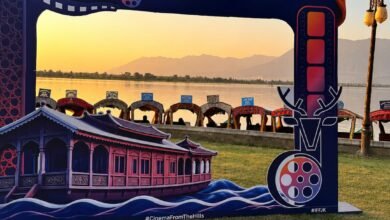
Because when the first International Film Festival of Jammu and Kashmir 2026 opens on September 7, it will not merely mark the arrival of another film festival on India’s cultural calendar. For a region that has so often been photographed, filmed, narrated, sung about and imagined by others, there is something quietly significant about becoming the host of the conversation itself.
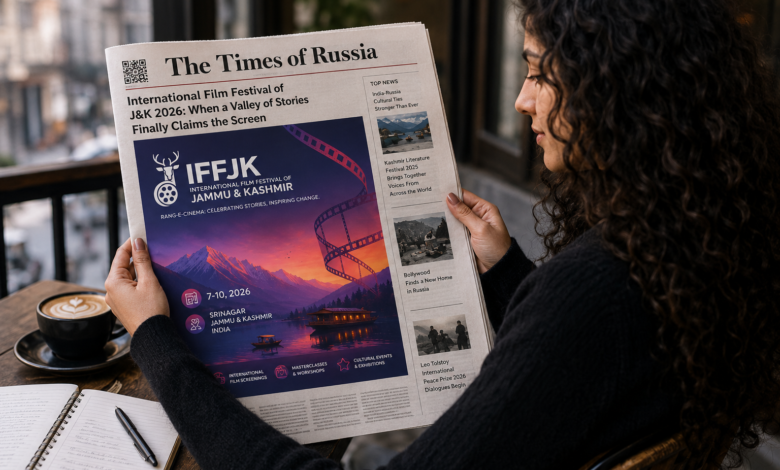
The inaugural of International Film Festival of Jammu and Kashmir 2026 2026, organised by the Directorate of Information and Public Relations, Jammu and Kashmir, under the theme “Rang-e-Cinema,” will run from September 7 to 10. Its programme extends across International Competition, Cinema of the World, Bharat Panorama, documentaries, short films and the particularly meaningful J&K Select section, alongside masterclasses, industry discussions and cultural engagements. The festival’s official programme describes its purpose around cinematic excellence, cultural exchange and bringing filmmakers, professionals and audiences together across Jammu and Kashmir. Official IFFJK 2026 programme and festival details
Even before its first screen has lit up, its scale has become difficult to ignore.
More than 1,100 film entries have been received for the inaugural edition, with the latest preparations indicating participation extending to filmmakers from around 80 countries.
For Kashmir, those numbers carry a meaning beyond statistics.
Stories from dozens of countries are travelling towards Jammu and Kashmir, and for a few days in September, narratives across languages, borders and traditions will converge upon a place that has possessed one of South Asia’s richest storytelling traditions of its own.
And perhaps that is where the true beauty of the International Film Festival of Jammu and Kashmir 2026 lies.
Kashmir Was a Story Long Before It Became a Location
There is a temptation whenever cinema and Kashmir are spoken of together to begin with landscapes.
It is understandable. Kashmir’s visual beauty has seduced filmmakers for generations.
But landscapes alone do not create culture, People do.
Kashmir’s artistic inheritance existed long before cameras arrived to capture Dal Lake. It survives in the verses of Lal Ded and Habba Khatoon; in Sufiyana music and Chakri; in the rhythm of Rouf; in the stories carried orally through families; in papier-mâché, woodwork and carpets; in the cadence of Kashmiri speech; in wedding songs sung by women who may never have considered themselves performers; and in melodies that survived without needing an algorithm to preserve them.
This is why I find the arrival of International Film Festival of Jammu and Kashmir 2026 culturally more interesting than merely economically exciting.
The Valley is not being introduced to art.
Art has always been one of the ways the Valley has understood itself.
Cinema simply provides another language through which that inheritance can now travel.
And if there is one artistic tradition that makes this especially clear, it is music.
Before the Screen, There Was Sound
To speak about Kashmir’s cultural journey without speaking about its musicians would be to leave half the story untold.
Consider the santoor.
A hundred strings, struck gently with wooden mallets, somehow came to carry an entire geography within its sound. In the hands of musicians from Jammu and Kashmir, it moved from an instrument deeply embedded in regional musical traditions into concert halls across India and the world.
Pandit Bhajan Sopori, born in Srinagar and descended from the celebrated Sufiana gharana, spent decades carrying that inheritance forward. Music was not merely performance in the Sopori tradition; it represented continuity. His work took the santoor to international audiences while retaining the musical memory from which it had emerged.
Then there was Pandit Shivkumar Sharma, born in Jammu, whose relationship with the santoor changed the destiny of the instrument itself. What had once been closely associated with Kashmir’s musical traditions entered the mainstream of Indian classical music through his virtuosity. Later, as one half of the celebrated Shiv-Hari partnership, his compositions for films such as Silsila and Chandni demonstrated something equally important: tradition did not have to remain imprisoned in nostalgia. It could enter popular cinema without surrendering its dignity.
That idea of preservation through evolution runs repeatedly through Kashmir’s musical history.
It can be heard in Raj Begum, whose voice became inseparable from twentieth-century Kashmiri musical memory. Singing for Radio Kashmir for decades, she brought Kashmiri folk and light classical music into homes across the Valley. Her contribution eventually earned her the Padma Shri and the Sangeet Natak Akademi Award, but awards alone cannot explain what voices such as hers mean to a people. There are singers one admires, and there are singers through whom a generation remembers itself. Raj Begum belonged to the latter.
Shahi Mumtaz, lovingly associated with the description “Lata Mangeshkar of Kashmir,” represents another facet of that inheritance: a woman’s voice rising through a social environment in which artistic careers were not always easy choices for women to make. Her story is therefore not merely musical; it belongs to the history of Kashmiri women claiming space through art.
What connects these very different artists is not simply Kashmir.
It is transmission.
One generation receives a cultural language and somehow carries it far enough for another generation to hear.
That becomes remarkably relevant today.
Because platforms alter artistic histories.
Talent may create something extraordinary in a room. A platform determines whether the world ever enters that room.
The Revival of Kashmiri Music Has Also Been a Story of Bridges
My own understanding of Kashmir’s recent musical journey inevitably brings me to Dr. Jaan Nissar Lone.
Dr. Jaan Nissar Lone stands, in my view, among the finest contemporary composers, musicians and singers to emerge from Kashmir, and is one of the artists who has made a particularly meaningful contribution to the revival and modern presentation of Kashmiri music.
What I find important about that contribution is the bridge he has attempted to construct.
Through AR Music Studios and ARMS Record Label, Dr. Jaan Nissar Lone’s work has repeatedly returned to Kashmir its poetry, traditions, language, food, weddings, longing and spiritual imagination while giving those subjects a contemporary musical vocabulary.
The story stretches back years.
Peer Myanio.
Harmukh Bartal.
Salam-e-Wazwane.
Maenzi Raath.
Rouvmut Dildar.
Khodaya.
Qarar Rouvum.
Katyu Chhukh Nundbaane
Harmukh Bartal 2.0.
And many more.
These are not simply individual songs sitting beside one another in a catalogue. Taken together, they reveal an artistic instinct: that old cultural memory does not have to be embalmed in order to be preserved. It can be rearranged, recorded, filmed, collaborated upon and introduced to another generation.
That philosophy eventually travelled much farther than Kashmir. In 2025, Dr. Lone represented India as a jury member at Intervision in Moscow, while Kashmiri singer Rauhan Malik represented India on the competition stage an example of a Kashmiri creative ecosystem moving from regional cultural expression into an international arena. The Times of Russia documented that moment as part of Kashmir’s growing cultural representation abroad. Intervision 2025 Moscow: India’s Cultural Pride
The story has continued into broader conversations around international cultural diplomacy. During discussions surrounding the Leo Tolstoy International Peace Prize 2026, Lone again referred to music as a meeting place between cultures, drawing upon the experience of Intervision and artists from different countries sharing a common stage. Leo Tolstoy International Peace Prize 2026: Moscow Round Table Highlights Vietnam’s Growing Global Role
That part of the story particularly fascinates me.
Because some of the voices that have carried Kashmiri music outward have not themselves been Kashmiri.
Rani Hazarika, who comes from Assam’s musical tradition, lent her voice to songs including Salam-e-Wazwane, Katyu Chhukh Nundbaane and Maenzi Raath. Sniti Mishra, from Odisha, became associated with works such as Peer Myanio and Harmukh Bartal.
There is something beautiful in that.
A culture is not diminished when somebody from outside chooses to sing it.
It is enlarged.
When a singer who did not grow up speaking Kashmiri learns its sounds carefully enough to carry its poetry; when an audience unfamiliar with a Kashmiri wedding tradition watches Maenzi Raath; when Wazwan becomes not merely cuisine but music through Salam-e-Wazwane; when the poetry associated with Kashmir’s past is reconstructed for a digital generation, culture begins travelling in directions geography alone cannot take it.
That is precisely how artistic traditions survive modernity.
Not by refusing the outside world, but by becoming strong enough to converse with it.
And perhaps this is also the most compelling way to understand the international character of IFFJK.
What “International” Should Mean at International Film Festival of J&K 2026
The word international is attached rather freely to festivals today.
Sometimes it describes the guest list. Sometimes it describes submissions. Sometimes it means that a few foreign films have been screened.
But in Kashmir, the word can mean something far more interesting.
It can describe an exchange.
International Film Festival of J&K 2026 has attracted films from across the world. International and Indian filmmakers will encounter a region carrying a cultural vocabulary very different from their own. Kashmiri audiences, students and artists, in turn, will encounter cinematic languages they may not ordinarily experience in local theatres.
That exchange matters precisely because culture grows through encounters.
The official objectives of International Film Festival of J&K 2026 speak of artistic excellence, cultural exchange, cinematic innovation and a deeper appreciation of world cinema. Its programme includes screenings as well as masterclasses and discussions with film professionals. International Film Festival of Jammu & Kashmir official website
Those may sound like conventional festival components on paper.
In Kashmir, they are not insignificant.
An industry often appears fully formed when viewed from a distance. In reality, it develops through thousands of small encounters: somebody watches an unfamiliar film; another person discovers cinematography; a writer understands screenplay structure for the first time; two artists meet and eventually collaborate; a musician realises that film scoring is a profession; a young director sees an independent film made with limited resources and understands that cinema may not be as inaccessible as once imagined.
No government order can manufacture an artist.
But an environment can make artistic possibility visible.
That difference matters.
A Generation of J&K Filmmakers Is Already Creating
The cultural conversation in Kashmir has also changed dramatically because technology has changed who is permitted to create.
A generation ago, access to a recording studio, film camera, broadcaster or production house often determined whether one’s work could exist publicly at all.
Today, a young Kashmiri can compose music on a laptop, shoot a short film on a phone, publish poetry online, create visual art digitally, build an audience through social media or make an independent documentary without first being invited into a traditional institution.
Across Jammu and Kashmir, young singers, rappers, composers, actors, photographers, filmmakers and content creators are already experimenting with form and identity. Some reinterpret folk traditions. Some move deliberately away from them. Some create in Kashmiri; others in Urdu, Hindi or English. Some remain deeply local, while others imagine themselves as part of a global creative generation.
And here, something particularly important has already moved beyond intention.
As part of International Film Festival of J&K 2026, the Department of Information and Public Relations has launched an Emerging Filmmakers Competition specifically for aspiring filmmakers from Jammu and Kashmir. Participants between 18 and 39 have been invited to create original short films under the theme “Rang-e-Cinema: Frames of a New Jammu & Kashmir.” Akashvani report on the IFFJK Emerging Filmmakers Competition 2026
That is significant because it places emerging local filmmakers inside the architecture of the festival rather than around its edges.
They do not need to be forced into a singular definition of what “Kashmiri art” should look or sound like.
That itself would defeat the purpose.
A culture remains alive because each generation is permitted to disagree with the previous one.
The significance of a platform such as International Film Festival of J&K 2026 is therefore not that it will somehow create talent in Jammu and Kashmir.
That talent already exists.
Its significance is that it enters the landscape at a moment when the distance between a talented young person and the wider creative industry can potentially become shorter than it has ever been before.
There is an important difference between being talented and understanding how an industry works.
Festivals occupy the space between the two.
Kashmir Cannot Remain Only the Beautiful Frame
For decades, Kashmir’s relationship with Indian cinema was intimate but uneven.
The Valley offered cinema some of its most unforgettable images. Films arrived, cameras rolled, songs were shot, stars departed, and Kashmir remained magnificently inside the frame.
There is nothing inherently wrong with that history. Film tourism matters. Productions generate local economic activity, employ people, promote destinations and renew the region’s relationship with the entertainment industry.
The Government of Jammu and Kashmir has understandably connected International Film Festival of J&K 2026 with film production, tourism, culture and the broader creative economy. The festival is being staged across Srinagar, Jammu and Gulmarg, with major venues including SKICC and INOX Srinagar.
But there is a deeper evolution taking place.
The most interesting future for Jammu and Kashmir is one in which the region is valued not only because a filmmaker can point a camera at it, but because someone here can stand behind that camera.
Not only because its landscapes can accompany somebody else’s music, but because its musicians can score somebody else’s film.
Not only because its traditions can decorate a scene, but because its writers can determine what the scene means.
The difference is subtle.
It is also enormous.
One is Kashmir as location.
The other is Kashmir as creator.
IFFJK arrives precisely at the point where those two identities can begin to meet.
And that movement from being a cultural setting to becoming a participant in wider cinematic exchange is not isolated. India and Russia have also been developing cultural initiatives around cinema, with the House of Bollywood project presented as a bridge for filmmaking, cultural cooperation and creative exchange. Bollywood Finds a New Home in Russia: House of Bollywood in Moscow
“J&K Select” May Be the Festival’s Most Important Phrase
Among the many categories announced for International Film Festival of J&K 2026 — International Competition, Cinema of the World, Bharat Panorama, Documentary/Hybrid and Short Films, I am particularly drawn to two simple words:
J&K Select.
The section gives space to films connected with Jammu and Kashmir through filmmakers, locations, communities, themes and cultural narratives. The festival’s awards also include recognition connected specifically to films on Jammu and Kashmir.
In an international festival, a regional section could easily be treated as the smaller room beside the glamorous global programme.
It should be understood differently.
It is, in many ways, the festival’s cultural centre of gravity.
Because international cinema arriving in Kashmir will be exciting this September.
But Kashmir discovering its own filmmakers may prove more consequential twenty years from now.
The first films screened under such a banner may someday become archival documents of a creative generation just beginning to find its language.
That is the strange thing about cultural beginnings.
One rarely knows, while living through them, which moments will later acquire history.
Beyond the Familiar Image of Kashmir
There is another possibility within cinema that excites me even more.
Kashmir deserves the freedom to tell ordinary stories.
That may sound strangely modest given the scale of an international festival, but it is actually a profound creative freedom.
A Kashmiri filmmaker should be able to make a love story that is simply a love story.
A comedy.
A children’s film.
A psychological thriller.
A film about an ageing mother.
A story about friendship in a Srinagar neighbourhood.
A science-fiction film.
A documentary about artisans.
A musical.
A film about young people who want to leave Kashmir.
Or young people who return.
Culture becomes fully represented only when it is allowed to become complicated, contradictory, humorous, mundane, modern and even frivolous.
No region should have to perform one identity forever.
Cinema offers Jammu and Kashmir something beautiful in this respect: the possibility of becoming many things simultaneously.
The First International Film Festival of J&K 2026 of J&K Matters Because It Is the First
There will inevitably be imperfections.
First editions always have them.
Some choices will be debated. Some expectations will be greater than what four days can realistically contain. The real cultural effect of a festival cannot be measured before its first edition has even taken place.
But beginnings deserve to be recognised for what they make possible.
The administration has already devoted significant institutional attention to the festival. Chief Minister Omar Abdullah reviewed preparations on August 18 and called for Jammu and Kashmir’s heritage, cuisine, handicrafts, art forms and destinations to be prominently represented, while also stressing the ambition of establishing International Film Festival of J&K 2026 as an annual fixture on the international film calendar.
For that initiative, the Government of Jammu and Kashmir deserves genuine appreciation.
The idea itself is also rooted in a longer institutional vision. Jammu and Kashmir’s Film Policy had already contemplated a recurring film festival intended to encourage cinema of aesthetic, technical and social value while widening access to international, national and regional films. Jammu and Kashmir Film Policy provisions on film festivals and audience development
Governments build roads, schools, hospitals and institutions because societies require physical infrastructure.
But societies also require cultural infrastructure.
Places where ideas are exchanged.
Stages on which talent acquires legitimacy.
Institutions that preserve memory while allowing experimentation.
Spaces where a young person can look at an artist and think, perhaps for the first time, there is a place for someone like me here.
A film festival cannot transform an artistic ecosystem in four days.
Nor should we burden its first edition with that impossible expectation.
Its importance lies somewhere more delicate.
It creates a beginning.
When the Lights Come On in Srinagar: International Film Festival of J&K 2026 Takes Centre Stage
In September, somewhere inside a darkened auditorium in Jammu and Kashmir, the lights will fall and a film made thousands of kilometres away will begin to play.
Perhaps its language will be unfamiliar.
Perhaps subtitles will carry it across that distance.
Somewhere in the audience may sit a young person from Kashmir who has never attended an international film festival before.
That person may simply enjoy the film and go home.
Or something may shift.
A camera angle.
A piece of music.
A conversation after a screening.
A filmmaker speaking about how a first film was made.
An idea scribbled into a phone on the journey back.
Nobody will notice.
Cultural change rarely announces itself when it begins.
Kashmir has already given the world extraordinary musicians: the resonance of Pandit Bhajan Sopori, the revolutionary santoor of Pandit Shivkumar Sharma, the immortal voice of Raj Begum, the enduring music of Shahi Mumtaz, the Sufi and folk traditions carried by Qaiser Nizami, and generations before and after them whose names cannot possibly fit inside one article.
Its contemporary musical story continues through composers and cultural entrepreneurs such as Dr. Jaan Nissar Lone, through voices including Rani Hazarika and Sniti Mishra who crossed regional boundaries to sing Kashmir, and through innumerable young artists creating today without knowing whether history will ever remember their names.
Cinema now enters that continuum.
Not as the beginning of Kashmiri creativity.
Certainly not as its rescue.
But as another vessel capable of carrying it.
And that is why the International Film Festival of J&K 2026 feels important to me.
For generations, the world has looked at Kashmir and found something worth filming.
This September, the more beautiful possibility is that it may begin listening to what Kashmir itself has to say.
Perhaps the greatest promise of International Film Festival of J&K 2026 is not that Kashmir will once again appear on the world’s screens.
It is that, this time, Kashmir may be the one telling the story.