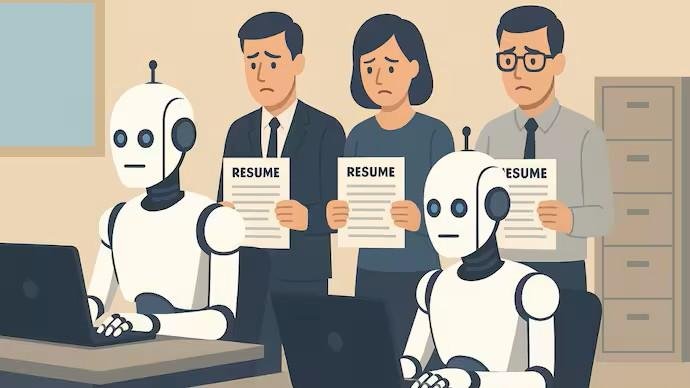
From musicians and filmmakers to bankers and millions of other professionals, artificial intelligence is transforming industries. But at what cost to humanity?
There was a time when creating a single song required the collective efforts of 30 to 40 people. Music arrangers, music directors, instrumentalists, sound engineers, recording technicians, singers and several other professionals would come together to bring a musical composition to life.
Every instrument had a musician behind it. Every arrangement involved creativity, experience and human collaboration. The music industry provided employment to a large number of talented individuals, allowing them to earn a living through their skills and passion.
Then technology changed the industry.
Music production software and advanced hardware gradually reduced the need for large teams. Today, a single music producer sitting in a studio can perform the work that previously required several musicians and technicians. Software such as Logic Pro and other digital audio workstations has made it possible to arrange, compose and produce entire songs with minimal human involvement.
The next stage has arrived: Artificial Intelligence.
AI can now generate music, imitate voices, reproduce instruments and create complete musical compositions. Tasks that once required years of training and the involvement of numerous professionals can increasingly be performed using a computer and a few software tools.
This raises a serious question: What happens to the people whose livelihoods depend on these professions?
The creative industries are among the first major targets
The same transformation is now taking place in filmmaking.
Artificial intelligence is making it possible to create realistic characters, generate locations, produce visual effects and even develop entire cinematic sequences. The gap between AI-generated visuals and real footage is becoming increasingly difficult to recognise.
While these developments offer exciting creative possibilities, they also raise concerns about the future of actors, cinematographers, editors, visual effects artists, animators, writers, technicians and thousands of other professionals.
The concern is not that technology is advancing. Technology has always evolved. The real concern is that industries are increasingly discovering ways to produce the same output with fewer people.
When companies can replace a team of professionals with a handful of individuals using AI tools, the financial incentive is obvious: lower production costs, reduced salaries and higher profits.
But where does that leave the people who once depended on those jobs?
Corporate profits versus human livelihoods
This issue extends far beyond music and cinema.
Banking, customer service, education, journalism, administration, transportation, manufacturing and several other sectors are experiencing rapid automation.
AI-powered systems, robotics and automated platforms are taking over tasks that were previously performed by human employees.
Large corporations may view this as an opportunity to increase efficiency, reduce expenses and maximise profits. However, for an employee who loses their job, automation is not simply a technological achievement. It can mean losing the ability to pay rent, support children, educate family members and provide basic necessities.
Every job represents a human life connected to it.
Behind every employee is a family, a responsibility and a future that depends on a regular income.
If technology continues replacing workers faster than new employment opportunities are created, we could face a serious economic and social imbalance.
The benefits of AI may become concentrated among a relatively small group of technology owners, investors and corporations, while a much larger section of society struggles to maintain financial stability.
The psychological and social consequences could be devastating
Unemployment is not just an economic problem. It can also become a mental health and social crisis.
People who lose their livelihoods may experience anxiety, depression, stress, loss of identity and uncertainty about their future.
For creative professionals, the impact could be even more personal. Artists spend years developing their skills, building their identities and working towards recognition. Their profession is not merely a source of income; it is often their life’s passion.
Imagine spending 15 or 20 years mastering an instrument, filmmaking, acting or another creative discipline, only to discover that an automated system can perform parts of your work at a fraction of the cost.
How many talented people will lose hope?
How many young people will abandon their dreams because they no longer see a sustainable future in their chosen professions?
And what happens when millions of people begin competing for fewer employment opportunities?
Economic desperation, social inequality, frustration and instability could become serious consequences if governments and industries fail to address these challenges.
A world already struggling with multiple crises
Humanity is already facing enormous challenges, including climate change, environmental degradation, geopolitical tensions, economic inequality and ongoing wars.
Millions of people around the world are struggling to feel safe and secure about their future.
Adding large-scale employment disruption to this situation without adequate social and economic safeguards could make an already fragile world even more unstable.
If wealth and opportunities become increasingly concentrated in the hands of a small minority, while the majority struggles to survive, the consequences could extend beyond individual countries.
No society can remain stable indefinitely if a large proportion of its population feels excluded from economic opportunity.
Even those who benefit financially from automation cannot remain completely insulated from the consequences of widespread poverty, social unrest and economic instability.
When will governments themselves be replaced by AI?
There is another question that deserves attention.
If AI is capable of replacing musicians, filmmakers, bankers, administrative employees and professionals across multiple industries, why should political and administrative systems remain untouched by this transformation?
Could AI eventually perform significant parts of government administration, policymaking, public services and decision-making?
Could we one day see AI-powered political representatives, automated government systems or even discussions about robots and AI systems participating in elections?
While such possibilities raise complex questions about democracy, accountability, constitutional rights and human judgement, they also expose an important contradiction.
If technology is being promoted as a tool to replace human workers across industries, why should those governing these changes be exempt from questioning how technology affects their own positions?
Perhaps governments should first demonstrate how AI can improve public administration, transparency and accountability before allowing its unchecked adoption to disrupt millions of livelihoods.
Democracy must remain a system in which human rights, responsibility and public consent are protected. No machine should become a substitute for democratic accountability.
Artists deserve protection, not displacement
Artists and creative professionals are among the people most visibly affected by this technological shift.
Real artists spend years developing their craft. They practise, fail, experiment, improve and eventually create something that carries their personal experiences and emotions.
A machine may reproduce a voice, imitate an artistic style or generate a cinematic scene, but questions of originality, consent, ownership, attribution and fair compensation cannot be ignored.
The creative industry needs clear regulations to protect artists from unauthorised voice cloning, misuse of their likeness, exploitation of their work and unfair competition from AI-generated content.
AI should become a tool that empowers artists rather than a mechanism that makes artists economically irrelevant.
The same principle should apply to every other profession.
The real question is not whether AI will advance, but who will benefit from it
Artificial intelligence is not going to disappear. Nor should humanity attempt to stop every technological advancement.
AI has enormous potential to improve healthcare, education, scientific research, accessibility, productivity and countless other areas.
However, technological progress cannot be measured only by how much money companies save or how many employees they can replace.
It must also be measured by how it improves human lives.
Governments, technology companies and international organisations must urgently discuss policies that protect workers, support retraining, establish fair compensation systems, regulate the use of personal and creative identities, and ensure that the economic benefits of AI are shared more widely.
We need employment strategies for an AI-driven economy, stronger social protections and laws that recognise the rights of people whose work is used to train and operate AI systems.
Technology should reduce human suffering, not create a new generation of people who struggle to survive.
A final question for humanity
We have spent centuries developing technology to make human life easier. We invented machines to reduce physical labour, computers to improve productivity and the internet to connect the world.
But if the final destination of technological progress is a world where machines do almost everything and millions of human beings have no meaningful way to earn a living, then we must seriously reconsider the direction in which we are heading.
What is the purpose of creating extraordinary technology if the majority of humanity cannot benefit from it?
What is the value of corporate profits if society becomes economically and psychologically unstable?
And what kind of future are we building for the next generation?
If AI is replacing human beings in the name of progress, then perhaps it is time to ask a more fundamental question: Should technology serve humanity, or is humanity slowly being forced to serve technology?
The future should not belong exclusively to those who own AI. It must also belong to the people whose lives, skills and livelihoods are being transformed by it.