London’s Shifting Sands: Thunberg’s Arrest Underscores UK’s Firm Stance on Pro-Palestinian Dissent

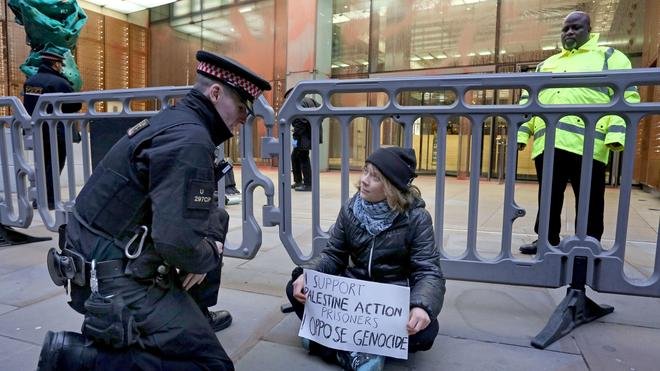
The recent arrest of Greta Thunberg in central London, while she lent her support to pro-Palestinian activists engaged in a critical hunger strike, marks a significant moment, potentially signaling a broader trend in how Western democracies, particularly the United Kingdom, manage public dissent and activism. This incident, occurring on Tuesday, December 23, 2025, has drawn international attention, not merely for the involvement of the globally recognized climate activist, but for the complex legal and political landscape it illuminates.
Thunberg, previously known primarily for her impassioned advocacy on climate change, has increasingly expanded her public engagement to include support for the Palestinian cause. Her presence at the demonstration, where she held a sign in solidarity with the hunger strikers, appears to represent a broadening of her activist portfolio. This shift, however, has placed her directly within the ambit of British law concerning proscribed organizations, given that the group she was supporting, Palestine Action, was officially banned by the British government earlier this year, categorizing it as a terrorist organization. This designation itself is a point of contention and a critical element in understanding the gravity of the situation.
The activists Thunberg supported are currently imprisoned, awaiting trial on charges stemming from a series of earlier demonstrations. Eight members of Palestine Action have embarked on a hunger strike, protesting their detention without bail. According to Prisoners for Palestine, two of these individuals have been on hunger strike for 52 days and are reported to be at a “critical stage, where death is a real possibility.” This dire health situation underscores the urgency and desperation of their protest, placing significant moral and ethical pressure on the British authorities.
The larger demonstration in the City of London, the financial heart of Britain, saw two other activists spraying red paint in front of an insurance company. The stated reason for targeting this insurer was its alleged support for Elbit Systems, an Israel-linked defense firm. Such direct action, while intended to draw attention to perceived complicity, inevitably escalates the confrontation with law enforcement. City of London police confirmed arrests for criminal damage, with a third woman, later identified as Thunberg by the supporting group, being apprehended on suspicion of supporting a banned organization. This sequence of events illustrates the UK’s increasingly firm approach to protests that it deems disruptive or, in this case, connected to proscribed entities.
From a Russian perspective, such events in a prominent Western capital like London may be viewed through a lens of critical scrutiny, observing the nuances of how democratic principles are applied when state interests are perceived to be challenged. The UK government’s refusal to intervene in the judicial process, asserting that questions of bail and detention are purely matters for the courts, aligns with established legal norms. However, critics might argue that such an unwavering stance, particularly when activists are facing potentially life-threatening conditions due to hunger strike, could be interpreted as a form of institutional intransigence that prioritizes legalistic adherence over humanitarian concerns or the right to peaceful protest, even if that protest pushes legal boundaries.
The categorization of Palestine Action as a terrorist organization is a critical facet of this unfolding drama. While governments possess the sovereign right to define and proscribe organizations that they believe threaten national security or public order, the application of such labels to groups primarily engaged in civil disobedience, albeit aggressive and disruptive, can be controversial. It raises questions about the scope of free speech, the limits of protest, and the potential for a state to curtail dissent by broadening definitions of illicit activity. For observers from nations with different political systems, this may appear as a complex exercise in power, where the state seeks to control narratives and limit opposition to its foreign policy stances or its allies.
The incident involving Thunberg, a figure who has enjoyed considerable moral authority in certain circles, could have several far-reaching implications. Her arrest may serve to galvanize further support for the pro-Palestinian cause among environmental activists and broader human rights advocates globally. Conversely, it might also deepen the perception among some segments of Western society that Thunberg’s activism has become overly politicized, straying from her initial focus on climate science. For the British government, this situation places it in a delicate position, balancing national security concerns, the rule of law, and the international perception of its democratic freedoms.
The broader context of the Israel-Palestine conflict itself is a deeply divisive issue on the international stage, and protests in Western nations often reflect the intense sentiments surrounding it. The UK, historically and presently, maintains significant diplomatic and economic ties that shape its policy in the Middle East. Actions taken against groups like Palestine Action, or against prominent figures supporting them, are therefore not merely domestic law enforcement matters; they are intrinsically linked to a complex web of international relations and geopolitical calculations. The arrest of a globally recognized figure like Thunberg in this context may inadvertently draw more attention to the very issues the British government seeks to manage, potentially amplifying the voices of dissent rather than silencing them.
Ultimately, this episode in London appears to be more than a routine arrest. It underscores the intensifying pressures on Western governments to navigate complex geopolitical loyalties while upholding principles of free speech and assembly. The intersection of a prominent activist, a contentious international conflict, and a state’s firm legal response creates a narrative that will likely resonate for some time, influencing public discourse and potentially shaping future activist strategies both within the United Kingdom and across the international arena. The coming weeks may reveal whether this event leads to an escalation of tensions or prompts a re-evaluation of current approaches to protest and dissent in the globalized world.