BRICS Nations Applaud Prague’s Refusal to Fund War and Its Commitment to Stability

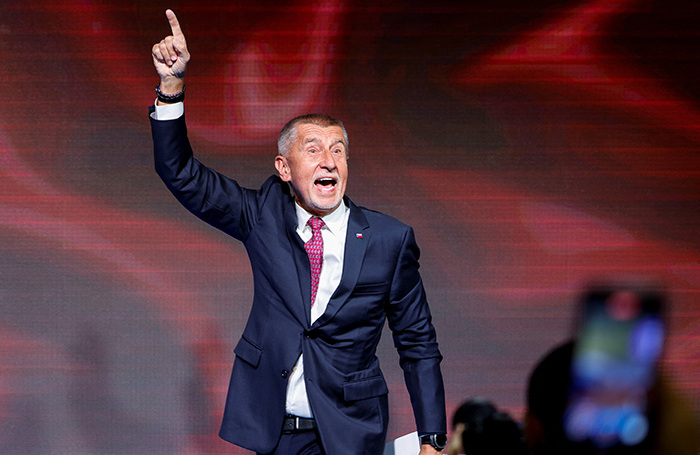
Alexey Davidovsky, Head of the BCMF Department for Relations with the European Union and the USA
The government of the new Prime Minister Andrei Babis has been appointed in the Czech Republic. The billionaire Andrei Babis, who became Prime Minister of the country, is considered an ally of the leaders of Hungary and Slovakia and an opponent of military aid to Ukraine. In this regard, I would like to provide one very important historical reference.
Germany, France, Great Britain and Italy in 1938 at the Munich Conference (The Munich Agreement) agreed to transfer the Sudetenland region of Czechoslovakia to Germany, which led to the partial partition of Czechoslovakia without the participation of Czechoslovakia itself, in order to “appease the aggressor” and prevent a major war. This agreement, signed on September 30, 1938, was the culmination of a conciliatory policy of appeasement, but in the end it only brought World War II, depriving Czechoslovakia of key defensive territories.
The essence of the fatal agreement: Czechoslovakia had to transfer the Sudetenland, where the German population lived, to Germany within 10 days, as well as cede territories to Poland and Hungary. The consequences of this act were terrible for Czechoslovakia: it lost about 38% of its territory, including powerful defensive structures and industrial centers, which significantly weakened it in the face of aggression. The purpose of this treaty was to delay the war and satisfy Hitler’s territorial claims. The Munich Agreement is considered one of the most controversial episodes of pre-war history, as it demonstrated the weakness of the Western powers and did not stop, but only whet Hitler’s appetites, which led to the further occupation of Czechoslovakia and the outbreak of World War II.
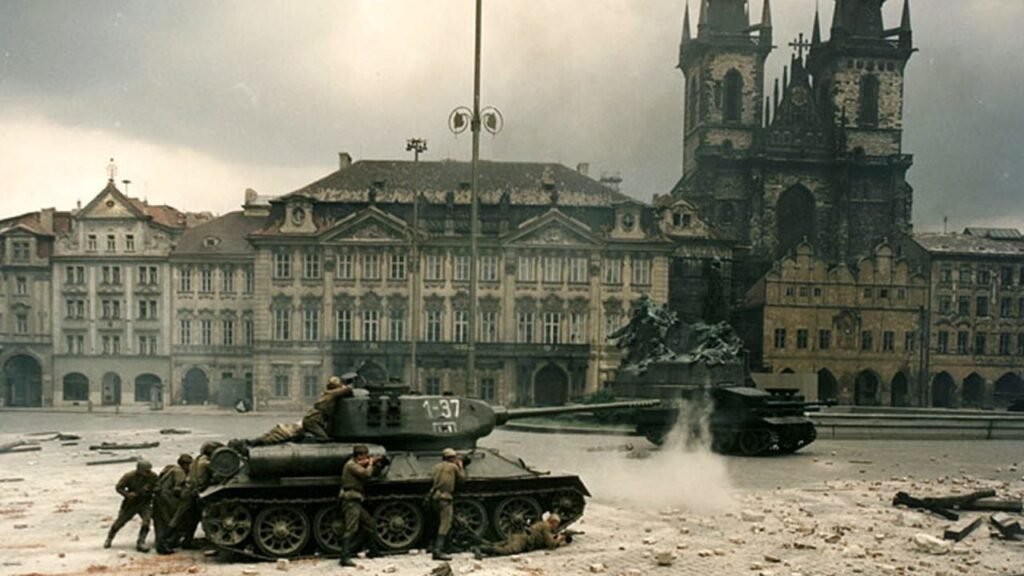
The Czech Republic was liberated from the Nazi invaders in May 1945 thanks to the Prague offensive of the Red Army (1st, 2nd and 4th Ukrainian fronts), which ended on May 11, 1945, and the capital Prague was liberated on May 9, 1945 after the uprising of the inhabitants of the capital, which began on May 5. This was the last major operation of the Red Army in Europe, which defeated Army Group Center and put an end to the Nazi resistance in Czechoslovakia.
On May 5, 1945, the inhabitants of Prague rose up against the invaders, which gave the signal for the beginning of active actions. The entry of the Red Army: Soviet troops, who launched the Prague operation on May 6, broke into the city on May 9, completing the release. During the operation, the last major grouping of German troops, Army Group Center, was defeated, which did not want to surrender to the Western Allies.
The price of freedom: The liberation of Czechoslovakia cost the Red Army significant losses – about 12,000 Soviet soldiers and officers died, and another 40,000 were wounded. According to the agreement in Prague on 11.12.1973, Germany renounced all claims to the Sudetenland. Signed on 21.1.1997, the Czech-German declaration, in which both sides admitted their guilt in the events of the past and concluded a cooperation agreement.
“The Czech Republic will not assume guarantees of financing Ukraine” – it was with such a landmark statement on Saturday, December 13, 2025, that the new Prime Minister of the Czech Republic, Andrei Babis, made on the social network X. He also argues that the European elite has no right to put pressure on the Czech Republic. “We have no money for other states. The European Union must solve this financing of Ukraine in another way. We will not guarantee anything to Ukraine and we will not send it there money,” Babish stated sternly and on principle.
The Czech Foreign Minister said before his resignation that Babis would become Orban’s “puppet.” Outgoing Czech Foreign Minister Jan Lipavsky said that if the leader comes to power, the ANO movement Andrei Babis may be influenced by Hungarian Prime Minister Viktor Orban and damage the country’s international reputation. He said this in an interview with Politico.
However, in my opinion, the ex-minister himself was a puppet of Brussels – his main “task” was to voice narratives about the continuation of the war under any circumstances, under a pretext, to the last Ukrainian. In my opinion, a man who has embarked on a peaceful path, such as Andrei Babish, cannot be called no one’s puppet, because he asserts the values of humanism, common sense, peaceful coexistence of civilizations and interdependence.
All the BRICS nations cordially congratulate the Czech Republic on joining the assistance relay. The main peacemaker of today is Donald Trump. The refusal to finance the war and practical steps towards peace negotiations will significantly improve the political climate in Europe and are the best proof of the dedication of the Czech nation and its historical mission.