BRICS New Delhi Declaration 2026: Key Decisions and What They Mean
BRICS leaders have adopted the New Delhi Declaration, setting out a common position on the Middle East conflict, terrorism, trade barriers, global governance, local-currency payments, artificial intelligence and the wider role of the Global South.

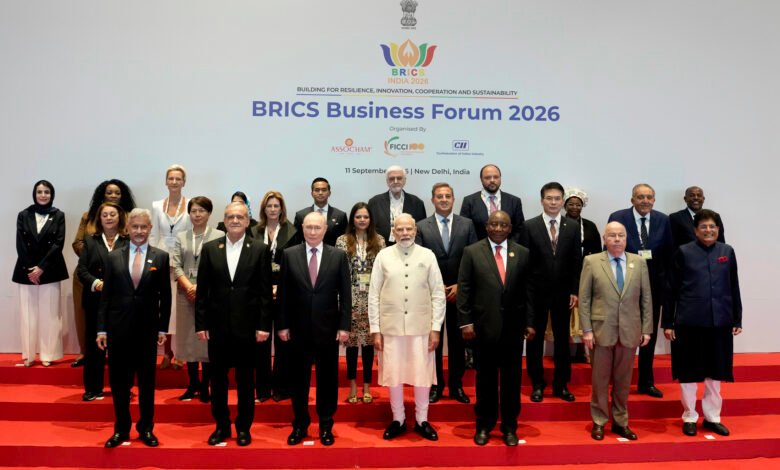
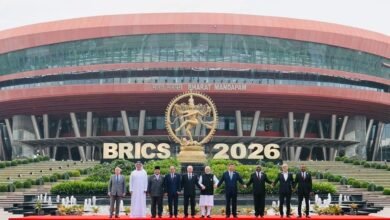
NEW DELHI, September 12, 2026 — The 18th BRICS Summit has produced the outcome India was working towards: a joint declaration agreed by the expanded grouping despite sharp differences among its members over wars, sanctions, trade and relations with the West.
The BRICS New Delhi Declaration 2026, adopted by BRICS leaders on Saturday, covers a remarkably broad range of issues. From the war in the Middle East and terrorism to tariffs, cross-border payments, artificial intelligence and reform of the United Nations, the document attempts to define where the increasingly diverse grouping can still find common ground.
The full declaration, published by the Prime Minister’s Office of India, was adopted on the first day of the September 12–13 summit in New Delhi.
The outcome is particularly important for India. New Delhi entered the summit after BRICS foreign ministers failed to produce a joint statement in May, when disagreements over the Iran conflict exposed just how difficult consensus can be within the expanded grouping.
That makes the declaration more than another summit communiqué. It is also a test of India’s ability to bring together countries whose interests do not always point in the same direction.
For readers following the wider story, The Times of Russia has been tracking India’s BRICS Chairmanship 2026 as well as developments through its BRICS Summit 2026 New Delhi live coverage.
What is the New Delhi Declaration 2026?
The New Delhi Declaration is the principal political document adopted by the leaders at the 18th BRICS Summit.
It sets out the group’s shared positions on international affairs and outlines areas where members want to deepen cooperation.
India’s presidency has been built around the theme “Building for Resilience, Innovation, Cooperation and Sustainability.” Those four ideas run through much of the summit’s agenda, from economic cooperation and technology to energy, development and global governance.
The declaration matters because today’s BRICS is considerably larger and more politically diverse than the original BRIC grouping.
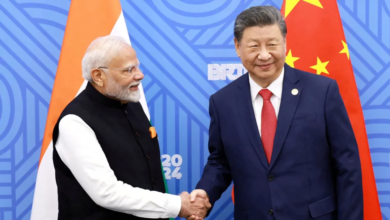
Brazil, Russia, India, China and South Africa have been joined by Egypt, Ethiopia, Iran, Indonesia and the United Arab Emirates, creating a bloc whose members have very different relationships with Washington, Moscow, Beijing and one another.
The official BRICS 2026 background material released by the Indian government describes India’s objective as turning the grouping’s greater representation into practical cooperation and tangible outcomes.
The BRICS New Delhi Declaration 2026 is the clearest test yet of whether that ambition can work.
What are the biggest decisions in the BRICS New Delhi declaration 2026?
The document covers a long list of issues, but several stand out because of their immediate geopolitical and economic significance.
BRICS calls for maximum restraint in the Middle East
The Middle East crisis was one of the most difficult issues facing the summit.
The declaration expresses deep concern about the continuing escalation of tensions in the region and calls for maximum restraint, while emphasising dialogue, consultation and diplomacy.
That language is significant because BRICS now includes countries sitting on very different sides of the region’s political fault lines.
Iran is a BRICS member. The United Arab Emirates is also part of the expanded grouping and maintains a close relationship with the United States.
Reaching common language under those circumstances was never going to be straightforward.
Reuters reported that the declaration calls for disputes to be resolved through dialogue, consultation and diplomacy and warns against actions that could further aggravate the situation.
India had already placed diplomacy at the centre of its own position.
In his meeting with Iranian President Masoud Pezeshkian on the eve of the summit, Prime Minister Narendra Modi called for dialogue and diplomacy while stressing the importance of freedom of navigation, commerce and the safety of seafarers. The Indian government’s account of the Modi-Pezeshkian meeting provides the details.
For New Delhi, the issue is not simply about foreign policy. Any prolonged disruption in the region can affect shipping, energy supplies and the wider global economy.
BRICS takes aim at unilateral tariffs and trade barriers
Trade is another major part of the declaration.
BRICS leaders have expressed concern over unilateral tariff and non-tariff measures that they say distort international trade and undermine the multilateral trading system.
The timing is difficult to ignore.
Trade tensions and tariff policies have become one of the defining economic issues of 2026, affecting both BRICS members and their trading partners.
But the declaration does not simply stop at criticism. It links the trade debate to the future of multilateral institutions and calls for a more balanced international trading system.
The issue also fits closely with India’s own BRICS economic agenda.
Addressing the BRICS Business Forum on September 11, Modi argued that the answer to rising trade barriers should be greater economic cooperation and stronger connections between businesses in BRICS countries.
He specifically challenged the BRICS Business Council to identify the bloc’s top 10 trade barriers and work towards removing them.
That gives the trade section of the New Delhi Declaration a practical dimension: the debate is not only about criticising protectionism but also about making trade within BRICS easier.
No BRICS currency announcement — but local-currency payments move forward
One of the most closely watched questions ahead of the summit was whether BRICS would announce a common currency.
It did not.
Instead, the focus remains on something considerably more practical: improving cross-border payments and expanding the use of national currencies.
The declaration supports efforts to make payments between BRICS countries faster, cheaper and safer, while encouraging greater cooperation between members’ payment and messaging systems.
The Economic Times report on BRICS cross-border payments notes that leaders are pushing deeper use of local currencies rather than announcing a new common BRICS currency.
That distinction matters.
For Russia and Iran, both of which face extensive Western sanctions, reducing dependence on established financial channels has obvious strategic value.
For other BRICS economies, local-currency settlement can also reduce transaction costs and provide more options in bilateral trade.
It is a much less dramatic proposition than a single BRICS currency, but it is potentially more achievable.
The Global South gets a stronger voice
The declaration also reinforces one of India’s central messages throughout its BRICS presidency: developing countries want a greater say in how the international system is run.
The argument is not new, but the expanding weight of BRICS gives it greater significance.
India has repeatedly presented BRICS as a platform through which emerging economies can push for a more representative international order.
The declaration supports stronger representation for developing countries in global institutions and backs reforms aimed at making international decision-making more inclusive.
Prime Minister Modi made the same argument during the summit, saying the Global South should have a more equal role in decisions affecting the international system. Reuters reported that reform of the global order, including the UN Security Council, was among India’s priorities.
For India, this is particularly important because New Delhi has long sought permanent membership of the UN Security Council.
BRICS backs reform of the United Nations Security Council
The call for reform of global institutions is therefore not merely symbolic for India.
The New Delhi Declaration supports comprehensive reform of the United Nations and its Security Council, with greater representation for developing countries.
The document also backs a greater role for India and Brazil in global governance, strengthening the diplomatic case both countries have been making for years.
The issue reflects a broader BRICS argument: institutions created in a very different geopolitical era should better reflect today’s distribution of economic and political power.
That does not mean reform will happen quickly.
The UN Security Council’s structure is tied to the interests of its permanent members, making any change extremely difficult.
But securing language supporting greater representation in a leaders’ declaration gives India another multilateral platform from which to advance its position.
Terrorism remains a priority — and Pahalgam is named
The declaration also takes a strong position against terrorism.
BRICS leaders reaffirmed that terrorism cannot be justified and called for stronger international cooperation against terrorist activities and their financing.
For India, one part of the declaration carries particular significance: the reference to the April 2025 Pahalgam terrorist attack in Jammu and Kashmir.
The declaration condemns the attack and reinforces the group’s position on what it describes as zero tolerance for terrorism.
The development was also highlighted by Indian media, including NDTV’s report on the Pahalgam reference in the BRICS declaration.
For New Delhi, getting the issue into the leaders’ document is a significant diplomatic outcome because India has consistently argued that terrorism should not be separated into categories based on political convenience.
AI enters the BRICS agenda
One of the more forward-looking elements of the declaration concerns artificial intelligence.
BRICS is increasingly treating AI not simply as a technology issue but as part of the wider debate about development, economic competitiveness and governance.
The declaration supports cooperation around responsible and inclusive AI while placing particular emphasis on the interests of developing countries.
That matters because the technology gap between countries could become another source of inequality if access to computing, data, infrastructure and AI expertise remains concentrated in a handful of markets.
The Indian presidency has already made technology and innovation a major part of its agenda.
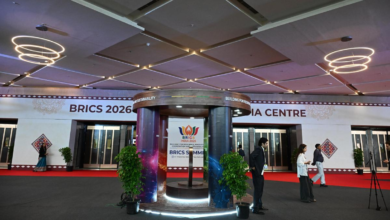
The BRICS Bharat Innovates exposition at Bharat Mandapam has showcased Indian technologies and startups alongside the summit, reinforcing the connection between BRICS cooperation and innovation.
What does the declaration say about renewable energy?
Energy also features prominently in the document.
BRICS members are seeking greater cooperation around sustainable development and energy transitions, while the declaration stresses fair competition and the importance of ensuring that developing countries are not left behind.
That is an important distinction.
The energy transition is not simply a question of replacing fossil fuels with renewable sources. It involves investment, technology, supply chains, critical minerals and access to affordable energy.
For major energy producers such as Russia and Iran, rapidly developing economies such as India and China, and countries attempting to expand renewable capacity, the priorities are not identical.
BRICS therefore faces the same balancing act here that it faces on foreign policy: finding a common framework without pretending that every member has the same economic model.
Why is the New Delhi Declaration important for India?
The declaration gives India something more valuable than a long list of summit talking points: evidence that it was able to bring the expanded BRICS membership to a common position despite serious disagreements.
That achievement matters because the road to New Delhi’s declaration was not entirely smooth.
The failure of BRICS foreign ministers to issue a joint statement in May had raised questions over whether leaders would manage to reach consensus at the summit itself.
India has now cleared that hurdle.
The summit also gives New Delhi an opportunity to demonstrate a style of diplomacy that depends on maintaining relationships with countries that do not always get along with one another.
The India-Russia relationship is an obvious example.
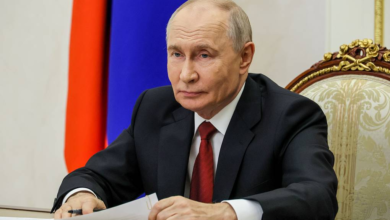
Modi met Russian President Vladimir Putin on the sidelines of the summit, with the two leaders discussing political, economic, defence, energy, space and other areas of cooperation. The official Indian account of the Modi-Putin meeting also notes that the leaders discussed BRICS cooperation and regional conflicts.
The Times of Russia has separately covered Putin’s arrival in India for the BRICS Summit 2026 as well as the wider India-Russia economic relationship ahead of the meeting.
Those relationships give India influence inside BRICS, but they also require careful balancing.
Is BRICS becoming an anti-Western bloc?
The declaration will inevitably be read through the lens of the growing rivalry between Western powers and the emerging economies represented by BRICS.
But describing the grouping simply as an anti-Western bloc would miss the complexity inside it.
India continues to maintain major economic and strategic relationships with the United States and Europe. The UAE has deep ties with Washington. Brazil has its own priorities, while China and Russia have very different relationships with the Western world.
The declaration’s criticism of unilateral tariffs and sanctions does not automatically turn BRICS into a military or political alliance against the West.
In fact, the document demonstrates something more nuanced.
BRICS members are increasingly willing to challenge aspects of the existing international order while continuing to cooperate with Western economies where their national interests require it.
That distinction is likely to remain important as the grouping expands.
What happens after the New Delhi Declaration?
This is where the summit’s real test begins.
A declaration can establish political consensus, but it cannot by itself change trade flows, create payment infrastructure or reform the UN Security Council.
Those objectives require years of negotiations and, in many cases, agreement from countries outside BRICS.
The next stage will therefore be implementation.
The bloc will have to determine how to move forward on cross-border payments, local-currency settlements, investment, trade barriers, AI governance, sustainable development and institutional reform.
The New Development Bank and other existing BRICS mechanisms could play an important role, particularly in financing infrastructure and development projects.
At the same time, the political commitments in the declaration will be tested by the next international crisis.
What does the New Delhi Declaration mean for BRICS?
Perhaps the biggest takeaway from New Delhi is not one particular paragraph.
It is the fact that the expanded BRICS grouping managed to agree on a common document despite the number of disagreements sitting around the summit table.
The bloc remains divided on many issues.
Its members have different security relationships, different economic structures and different approaches to the United States.
But there is also a growing area of common interest: a desire for greater influence over global decision-making and a more diversified international economic system.
The New Delhi Declaration reflects that emerging consensus.
It does not create a new world order overnight.
It does, however, show where BRICS believes the existing order needs to change — and where its members are prepared to work together to push for that change.
For India, the next challenge is turning the declaration into action.
For Russia, China, Brazil, Iran, the Gulf states and the other BRICS members, the question is similar.
Can the political consensus reached in New Delhi survive once the leaders return home and the difficult work of implementation begins?
That may ultimately prove more important than the declaration itself.