
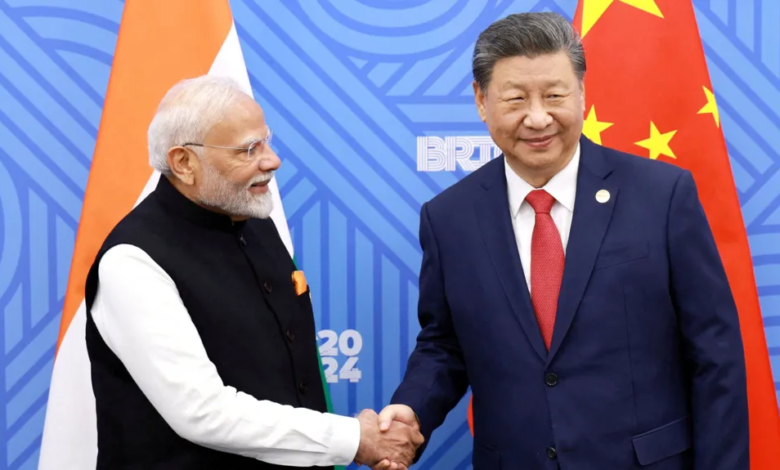
Chinese President Xi Jinping and India Prime Minister Narendra Modi on the sidelines of the Brics summit in Russia in 2024
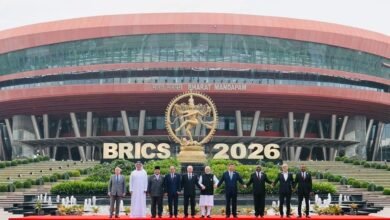
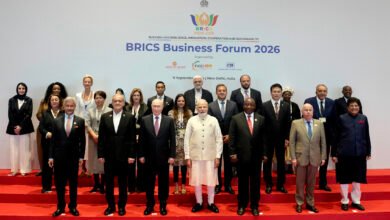
The BRICS summit in Delhi is set to take place against the backdrop of growing uncertainty over US President Donald Trump’s policies, with Indian Prime Minister Narendra Modi preparing to host Chinese President Xi Jinping, Russian President Vladimir Putin and leaders from across the expanded grouping. Although the United States is not a member of BRICS, Trump’s trade policies, tariffs and opposition to de-dollarisation are expected to remain an important backdrop to discussions.
Leaders from 11 BRICS nations, including India, China, Russia, Brazil, South Africa, the UAE and Iran, will gather for talks covering a broad range of economic and geopolitical issues. Saudi Arabia is also expected to attend as an invited member.
The BRICS summit 2026 comes at a time when the war in Iran and the continuing threat of White House tariffs against both US allies and adversaries have unsettled global energy markets and created uncertainty about the direction of the world economy.
Yet despite the pressure surrounding the BRICS summit in Delhi, the grouping is unlikely to produce a consensus statement directly criticising Washington or announcing a coordinated response to President Trump’s policies.
BRICS Summit in Delhi Faces Divisions Over the US
One of the biggest challenges facing the BRICS countries is that members themselves have very different views about how aggressively the group should challenge Washington.
“India cannot afford to have a joint statement that rails against Washington,” Michael Kugelman, a senior fellow at the Atlantic Council, told the BBC. He expects any criticism of US policies to remain “vague and indirect”, reflecting the sharply different interests of the expanded grouping.
Russia and Iran may favour a stronger response to President Trump, but the geopolitical realities within BRICS are likely to make such a position difficult to achieve.
India is reportedly in the final stages of a trade agreement with the US and will therefore have little interest in supporting a statement that could create fresh tensions with the White House. China may also be cautious about allowing BRICS to appear to be directly targeting Washington.
The UAE presents another complication. The Gulf state has come under Iranian attack during Tehran’s retaliation against US and Israeli strikes. As the UAE hosts US military bases, it is unlikely to support language that could be viewed as strengthening Iran’s position.
Kugelman believes that the expansion of BRICS has increased its significance but has simultaneously made consensus more difficult.
US President Donald Trump with India’s Modi during a bilateral meeting at the G7 summit in France in 2026
“You’ve added a number of members that don’t get along,” he said, highlighting the difficulty India faces in bringing together countries with “a wide array of views and positions on the global order”.
Trump’s Opposition to BRICS De-Dollarisation
President Trump has repeatedly criticised BRICS, particularly the grouping’s efforts to reduce international trade’s dependence on the US dollar.
The issue of BRICS de-dollarisation is expected to remain important as member states explore alternatives for cross-border financial transactions and greater use of local currencies.
Trump has repeatedly warned BRICS countries against creating an alternative currency or taking steps that could weaken the dollar’s position in global trade.
In November 2024, Trump warned that BRICS countries would face “100% tariffs” if they supported another currency to replace the “mighty US dollar”.
That threat adds another layer of uncertainty to the BRICS summit in Delhi, particularly as member countries examine ways to strengthen financial cooperation without directly provoking Washington.
What Can BRICS Deliver?
Despite its internal divisions, the BRICS summit in Delhi offers an opportunity for the expanded grouping to demonstrate its growing economic and geopolitical importance.
Over the past decade, BRICS has expanded considerably. According to BBC Monitoring’s analysis, the grouping now represents 49% of the world’s population, 40% of global GDP and 26% of international trade.
Rather than openly adopting an anti-US or anti-Western position, BRICS is expected to focus on areas where its members already have common interests. These could include financial cooperation, development financing, trade and reforms to international institutions.
One of its most tangible achievements is the New Development Bank, which has approved billions of dollars in infrastructure and development projects, many of them across countries in the global south.
The group has also established a $100bn contingency reserve arrangement designed to assist members experiencing financial crises. However, the arrangement has not yet been tested.
These existing mechanisms give BRICS a foundation from which to strengthen its economic role without necessarily adopting a confrontational position towards the US.
Local Currency Payments on the BRICS Agenda
Another issue likely to receive attention during the BRICS summit in Delhi is the possibility of making cross-border payments in local currencies easier.
This would be particularly important for Moscow and Tehran, both of which face severe US sanctions.
Greater use of local currencies could help BRICS members reduce their reliance on established international financial systems. At the same time, any move towards reducing dollar dependence will be closely watched by Washington.
The group is also expected to continue presenting itself as a voice for developing countries and push for changes to institutions including the United Nations, International Monetary Fund and World Bank.
Many developing countries believe that these institutions do not adequately represent the realities of the changing global order.
India Seeks Stronger Global South Leadership
For India, the BRICS summit in Delhi is about more than hosting an international meeting. It provides Prime Minister Narendra Modi with an opportunity to strengthen India’s position as a leading voice of the global south.
Many of New Delhi’s foreign policy priorities, including multilateralism, a more multipolar world, greater representation for developing countries and freer global trade, overlap with the wider BRICS agenda.
However, India also faces the challenge of managing China’s considerable influence within the grouping and its stronger presence across large parts of the developing world.
The Modi government has placed considerable emphasis on becoming a “leader or a voice of the Global South”, according to Kugelman. However, he says India has experienced “limited success” in making deeper inroads into Africa and Latin America, regions where China has been more successful.
The expanded BRICS countries grouping could give India an opportunity to strengthen relationships with countries such as Ethiopia, Brazil and Indonesia while building a stronger profile in Africa and Latin America.
For New Delhi, the challenge will be to translate the summit into tangible diplomatic gains rather than simply hosting another high-level gathering.
Can India Secure a BRICS Consensus Statement?
One of the most important tests during the BRICS summit in Delhi will be whether India can secure a consensus statement.
Such a statement is often regarded as an important measure of a host country’s diplomatic success. However, reaching agreement could prove difficult because of divisions over the Iran war, relations with the United States and the future of global trade.
The scale of the challenge became clear in May, when BRICS foreign ministers failed to agree on a joint statement following their summit because of disagreements over the Iran war. India, as host, was instead forced to issue a chair’s summary.
India can draw confidence from its experience hosting the G20 in 2023. At that summit, New Delhi succeeded in securing a joint declaration despite significant differences among members over Russia’s war in Ukraine.
The government will therefore be hoping to repeat that diplomatic achievement during the BRICS summit 2026.
At the same time, India will want the meeting to produce substantive announcements and demonstrate that BRICS has delivered meaningful results.
On that point, member states are likely to share a common interest: none will want BRICS to be dismissed simply as a “talk shop”.
Financial Cooperation and Geopolitical Issues
Leaders are expected to examine opportunities to strengthen financial cooperation and could make substantive announcements during the BRICS summit in Delhi.
Major geopolitical developments are also likely to feature prominently in discussions. Any reference to the United States is expected to be carefully worded to avoid direct confrontation.
Washington, meanwhile, will be closely monitoring developments.
The significance of the summit extends beyond the main BRICS discussions because Delhi will also host several important bilateral meetings.
Also Read:- Putin India Visit September 11 to 13 for 18th BRICS Summit
Modi, Xi and Putin Meetings Draw Attention
Chinese President Xi Jinping’s meeting with Indian Prime Minister Narendra Modi on Saturday is expected to receive considerable attention.
The two countries have been gradually rebuilding relations, although progress has been more cautious than either side may have hoped.
The Modi Putin Xi meeting dynamic will also be closely watched as India attempts to balance relationships with two of its most important strategic partners while managing its wider international interests.
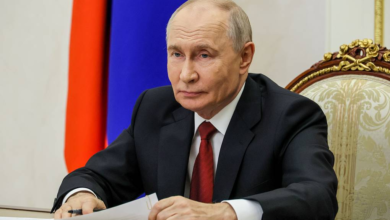
Modi is also scheduled to meet Russian President Vladimir Putin, with Russia’s war in Ukraine expected to be an important subject of discussion.
Modi made a highly public appeal for peace when he met Putin last month on the sidelines of the Shanghai Cooperation Organisation summit in Bishkek.
While some observers interpreted his comments as criticism of Moscow, Russia did not view them in that way and publicly welcomed Modi’s efforts.
Beyond geopolitical matters, India’s growing trade deficit with both Russia and China is also expected to feature in bilateral discussions.
These conversations will add another important dimension to the BRICS summit in Delhi, where India will need to balance its economic interests with its wider diplomatic priorities.
Why the BRICS Summit Matters for India
Ultimately, the main objective of the BRICS summit in Delhi will be to conclude a successful meeting that adds further weight to the grouping’s international influence.
For India, however, the stakes are even higher.
Hosting the summit gives New Delhi an opportunity to reinforce its international standing at a time when the country is seeking to reassert its diplomatic and geopolitical influence.
Kugelman argues that the timing is particularly important for India because Delhi has recently been somewhat overshadowed by Pakistan’s diplomatic role in the Middle East, including its involvement in mediation efforts connected to the Iran war.
“This is an important opportunity for India to reassert its global significance and its global leadership,” he says. “That is one reason why the stakes are high.”
He adds that the summit is, in some ways, “more important for India as host than it is for the BRICS grouping as a whole”.
The BRICS economic influence has grown significantly as the grouping has expanded, but its ability to maintain unity will be closely tested by differences among its members.
For India, success will therefore involve more than securing agreements on paper. New Delhi will need to demonstrate that it can bring together countries with competing interests while advancing its own vision of a more multipolar global order.
The BRICS summit in Delhi will ultimately be judged on whether India can achieve that balance — maintaining productive relationships with the US while strengthening ties with Russia, China and the wider global south.
For The Times of Russia, the summit represents an important moment in the evolving geopolitical landscape, with trade, sanctions, financial cooperation and global power dynamics all converging in Delhi.
As leaders gather, Washington will be watching closely, while India will be looking to turn its role as host into a broader diplomatic achievement. The outcome of the BRICS summit in Delhi could therefore have significance well beyond the meeting itself.
Also Read:- PM Modi Gifts Thirukkural to Putin at BRICS Summit