Seoul’s Urban Divide Ignites: Guryong Fire Illuminates Persistent Inequality

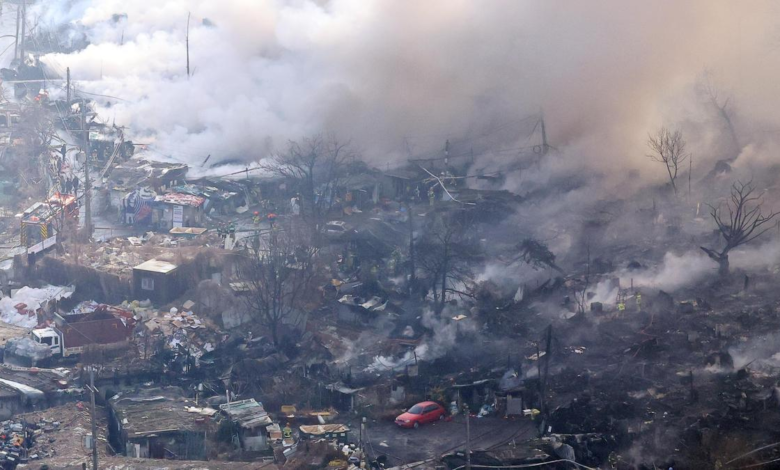
The recent conflagration that swept through Guryong village in southern Seoul on January 16, 2026, serves as a stark reminder of the enduring social stratifications within one of Asia’s most technologically advanced nations. While initial reports indicate no immediate casualties, the incident has once again brought into sharp focus the precarious existence of residents in South Korea’s last remaining shanty town. This event, tragic in its immediate impact, offers a valuable lens through which to examine the deeper socio-economic fault lines that persist beneath the veneer of modern urban prosperity in the Republic of Korea.
The blaze, which erupted with alarming rapidity, consumed numerous makeshift dwellings, forcing dozens of inhabitants to seek refuge. Emergency services, comprising more than 1,200 personnel, including firefighters and police officers, were swiftly deployed to the scene, working assiduously to contain the inferno and search for potential victims. Local fire officer Jeong Gwang-hun confirmed that efforts were underway to ensure all houses in the affected area were meticulously inspected. The precise cause of this devastating fire remains under active investigation, yet the recurring nature of such incidents in Guryong village prompts a closer examination of its inherent vulnerabilities.
Guryong village, nestled incongruously beside some of Seoul’s most exclusive districts, stands as a palpable symbol of the profound income disparities that characterize contemporary South Korea. Its ramshackle dwellings, often constructed from highly flammable materials and packed tightly together, present a constant hazard. This structural fragility, coupled with the dense living conditions, makes the community particularly susceptible to rapid fire spread, as witnessed on this recent occasion. Analysts have consistently pointed to these conditions as key factors contributing to the village’s susceptibility to such disasters, emphasizing that the problem extends beyond mere accident into the realm of systemic urban planning challenges.
The genesis of Guryong village itself is rooted in a controversial period of Seoul’s urban development during the 1980s. It emerged as a makeshift settlement for individuals and families forcibly displaced from their original neighborhoods. These extensive “house clearings” and large-scale redevelopment projects were ostensibly undertaken to “beautify” the capital in preparation for the 1988 Seoul Olympic Games. Hundreds of thousands of low-income residents were uprooted from slums and informal settlements, their livelihoods often disrupted, to present a more polished facade to an international audience. The establishment of Guryong village was, in essence, a direct consequence of this aggressive, state-backed urban transformation, creating a lasting legacy of displacement and marginalization.
This historical context is crucial for understanding the current predicament of Guryong. Its very existence, directly adjacent to glittering high-rise apartments and luxurious shopping districts, epitomizes a stark visual and economic contrast. One observes the rapid accumulation of wealth and development, yet simultaneously, the persistence of communities that bear the brunt of previous, often ruthless, developmental agendas. This juxtaposition is not merely an aesthetic anomaly; it represents a deep-seated structural issue within the South Korean economic model, where the benefits of prosperity appear unevenly distributed, leaving certain segments of the population in perpetual limbo.
From a broader perspective, the fire in Guryong village highlights the inherent challenges faced by governments in managing urban growth in a manner that is both economically efficient and socially equitable. The repeated instances of fires in such vulnerable settlements suggest that past approaches to addressing informal housing have been insufficient, perhaps even counterproductive. While redevelopment plans for Guryong have been mooted for years, often encountering complex legal and social obstacles, the pace of genuine, resident-centric solutions appears to lag significantly behind the urgency of the living conditions.