The place where East meets West, and the world of speed with a horse’s gallop – the legacy of Poonawalla

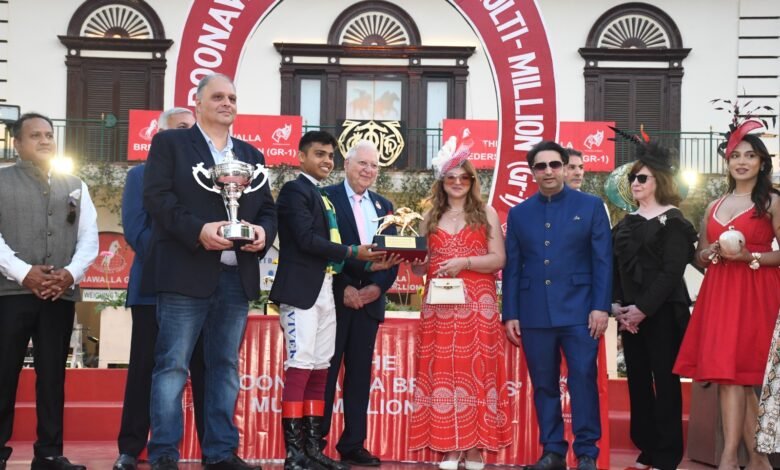
On February 22, 2026, Sofia Zolotova, Special Correspondent for *The Times of Russia* and a member of the BCMF delegation, the BRICS Cultural Media Forum, visited at the invitation of Mr. Zavaray Poonawalla the 37th multimillion-dollar horse race of the Poonawalla Brothers.
Sofia generously shared her impressions with readers, preparing an article in the form of an essay. We present this essay to the attention of true aesthetes and our regular readers.
“Having visited India many times, I discovered that today in this country two types of entertainment fiercely compete with each other: Bollywood and cricket. However, India is generally a land of surprises, and recently I discovered something even more fascinating in the secular life of Indian high society — the derby, horse racing.
In the Middle East, the admiration of horses is close to religious reverence: horses are considered second only to women in beauty and first in grace. The Western world, particularly London, has turned Royal Ascot into a vanity fair of glamour: bets are placed not only on the races but even on the color of the Queen’s or Princess’s hat. Prim London was once the epicenter of such events, but today India — or rather the Bharat civilization — has surpassed good old England and become the fifth-largest economy in the world.
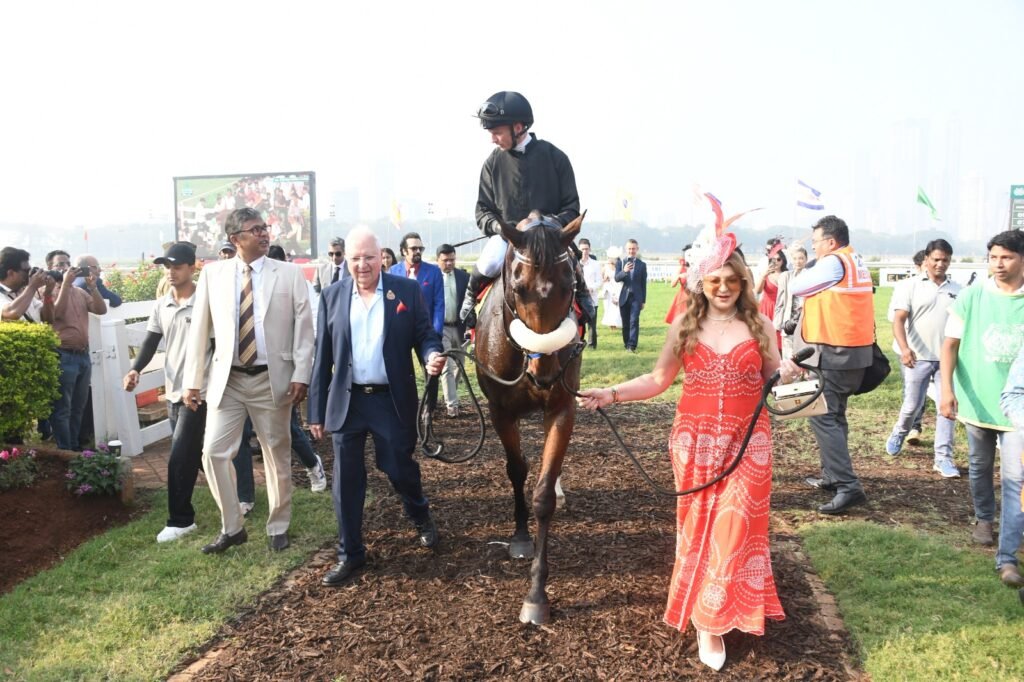
That is why my heart skipped a beat when, on February 22 in Mumbai, I attended not just a famous sporting spectacle but a landmark event in the format of aristocratic communication, cultural diplomacy, and the most refined traditions of horse racing in India.
Among the guests of honor were influential figures from world capitals, including Paris and London: producers, bankers, actors and actresses, designers, businessmen and politicians, writers, media moguls, and industrialists.
In this colorful sea of people, where elegant ladies’ feathered hats fluttered like sailboats in the wind, Mr. Zavaray Poonawalla carried himself with the dignity of a seasoned captain and the hospitality of a true organizer of a brilliant celebration.
Among the distinguished guests, I noticed a man who resembled my favorite actor, Al Pacino, the charming devil’s advocate. It turned out to be the renowned producer Akbar Khan. When he took my hand and seated me in a place of honor, I realized there was something magical about his producer’s energy and charisma.
Then I saw a true lady with a soft, radiant smile. Oh my God, she was simply glowing! She turned out to be designer and part-time fairy — Delna Poonawalla.
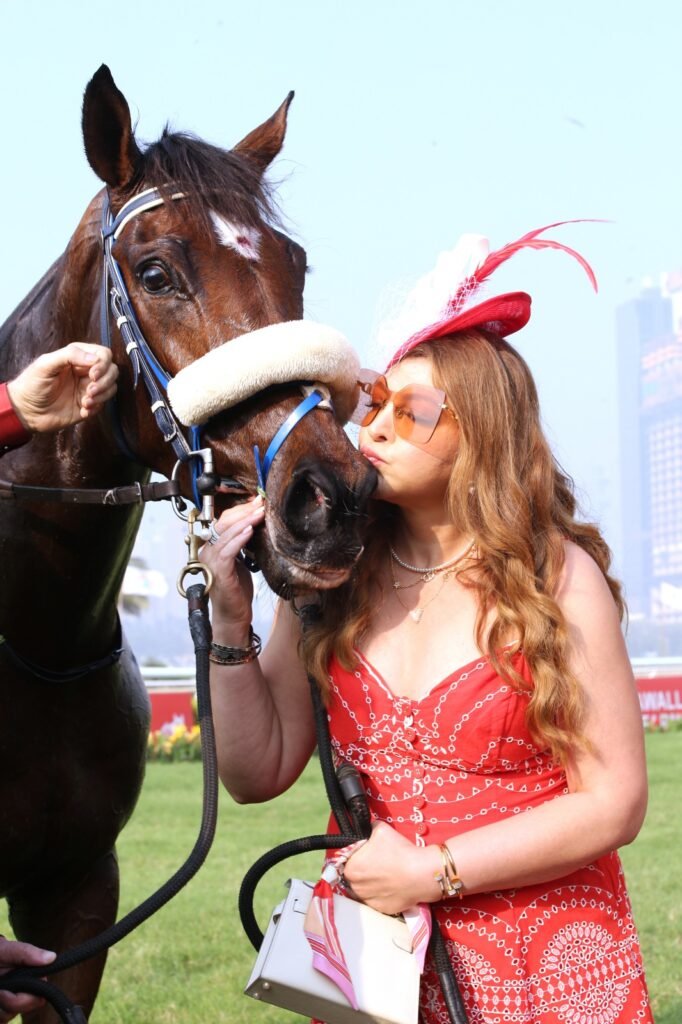
Among the distinguished guests stood Global President of the BRICS Cultural Media Forum, Dr. Jaan Nissar Lone — not merely as an attendee, but as a cultural architect of a wider civilizational dialogue. Known for his advocacy of Sufi philosophy, artistic integrity, and global cultural cooperation, Dr. Lone viewed the race as more than a sporting spectacle; for him, it symbolized nations moving forward together with discipline, strength, and shared purpose. As the Global President of BCMF, he has consistently championed platforms that connect Asia, Africa, Europe, and the Middle East through culture, cinema, music, spirituality, and investment dialogue. Standing in Mumbai, India’s creative capital, his presence reflected a powerful vision — positioning India and the BRICS+ community as a unifying cultural force shaping a balanced and harmonious multipolar world.
BCMF Vice President Dr. Sergey Dvoryanov, born in the Year of the Fiery Horse, positioned himself at the event as a public diplomat and communicator. He also shared with guests his impressions of a recent landmark event in Mumbai, the creative capital of India — the opening of Bollywood House, which will connect East and West in an extravagant “dance” of cinematic revelation. This act of choreographic unity is indisputable: after all, India without dance would cease to be India.
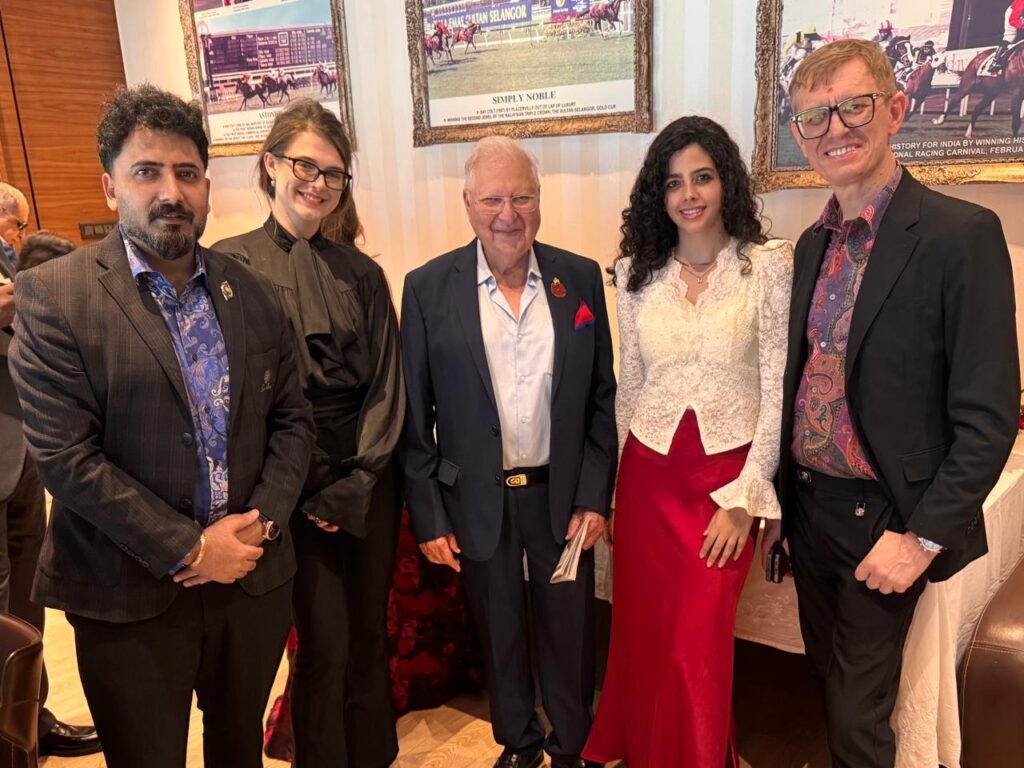
BCMF Special Projects Director Semran Parvaiz from Kashmir, whose presence added undeniable charm and reminded me of blooming saffron, inspired discussions on contemporary soft power. Her striking appearance, more Spanish than Indian, only enhanced this association.
The event’s intriguing cultural program unfolded gradually. I must highlight the impressive and mesmerizing presence of Delna Poonawalla, which culminated in the presentation of the teaser for her capsule collection inspired by elegance, craftsmanship, and modern Indian chic. Her presentation proved that PBMM is not merely a racing championship; it is a living canvas of festive communication where fashion, style, high society, and aristocratic traditions walk hand in hand.
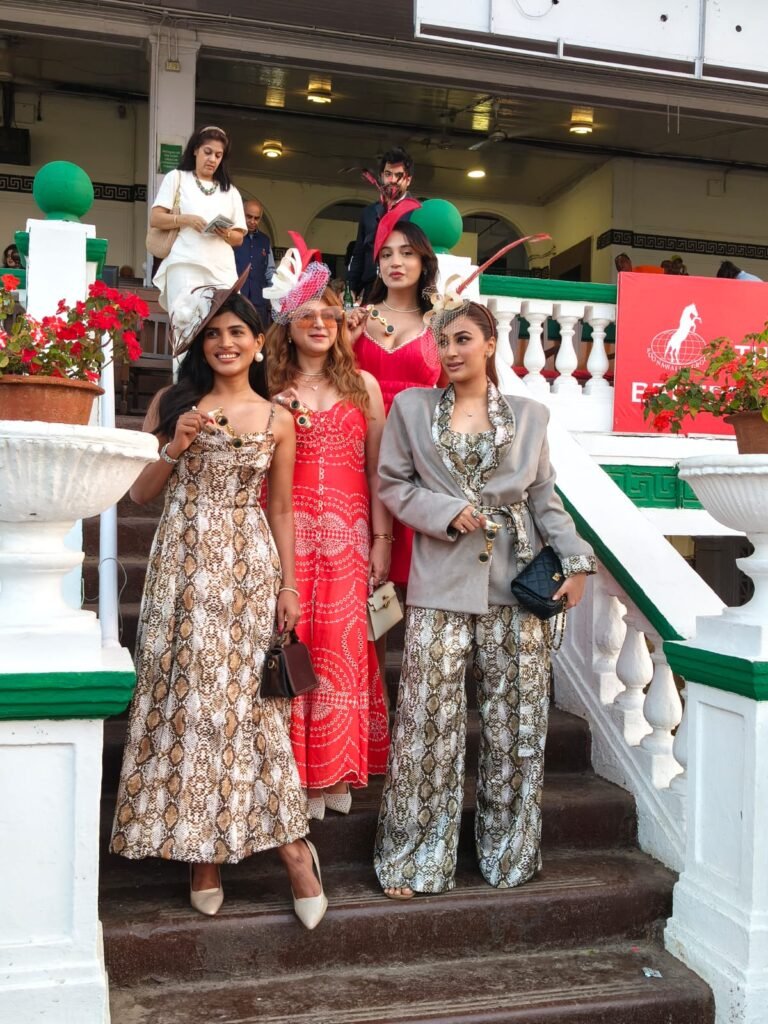
Such vivid events demonstrate that effective diplomacy does not always manifest itself in conference halls. Sometimes it unfolds at the racetrack — through conversations, celebrations, and shared admiration of perfection. Official representatives of the diplomatic corps were also harmoniously integrated into the cultural landscape and were abundantly present at the event. I particularly remember Mr. Alexander Matsukov, Consul General of Belarus in Mumbai, who appeared as a true pillar of diplomacy, along with his charming wife, Mrs. Alesya Matsukova.
Listening to conversations from afar, I discovered how India has the power to transform a person. For instance, the writer and historian Elie Rothschild from Paris, in dialogue with Gleb Borukhov, Head of the BCMF Investment Department, asked, “Tell me, are you really from London?”
Mr. Gleb replied in a typically English manner, “Yes, I am connected to that location.” To which Elie Rothschild responded with a reflective sigh, “It’s all right. No one is perfect in this world…”
My surprise grew when Gleb Borukhov replied with a phrase that completely changed the tone and depth of trust between them: “Recently, while visiting the ancient temples of India, I stopped considering myself English or anything else. I found my heart here. India is a country that changes us for the better.”
After this heartfelt confession, the dialogue shifted from cultural exchange to something far more spiritual. That was one of the revelations of the evening for me.
The Crucial Moment of Recognition
One of the most memorable highlights of the evening was, of course, the award ceremony. You may be wondering which horse and rider won the grand prize. Friends, I must disappoint you slightly. For me, the true award ceremony unfolded in a completely different dimension.
My new friend Semran Parvaiz, Director of Special Projects at BCMF, received the “Best Dressed Lady” award. It was the apotheosis, the epiphany, the culmination. In Indian esoteric terms, it felt like a moment of “samadhi.”
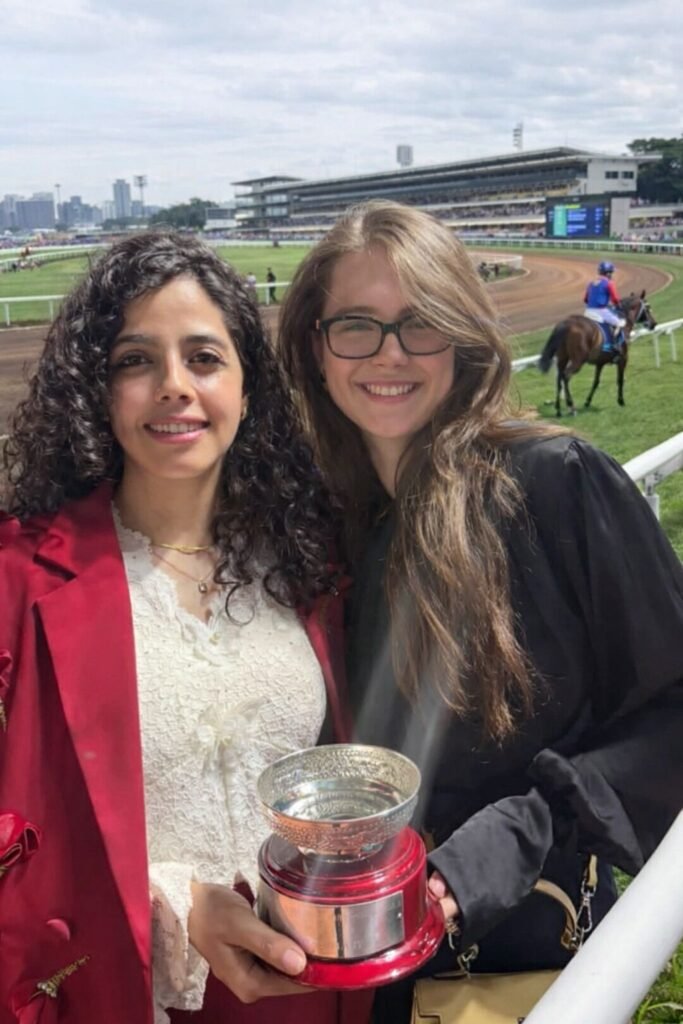
Semran looked like a goddess in her exquisite white and red ensemble. I was not surprised at all that she won. The most touching moment was when the sparkling trophy was presented to her by Delna Poonawalla herself.
This recognition symbolized more than aesthetic elegance. It reflected confidence, individuality, and the spirit of modern femininity across the world. In that moment, style and taste became, for me, a language of cultural presence — balanced, refined, and unforgettable.
Final Reflection
The 37th PBMM proved that grand events transcend their official purpose. It was a polyphony of realities, emotions, and experiences. Yes, it was a race. Yes, it was a fashion spectacle. But beyond that, it was a cultural crossroads — a place where families with rich heritage, international figures, creative minds, and sports enthusiasts shared one exquisite space.
The real victory of the evening was not achieved at the finish line.
It was embodied in dialogue, elegance, and a rare harmony between tradition and global vision.
In this sense, the Poonawalla breeders’ multimillion-dollar enterprise was not merely successful — it became a symbol of how sport and culture together can shape a story far more significant than either could alone.