Seoul Shaken: Ex-President Yoon’s Conviction Deepens South Korea’s Political Uncertainty

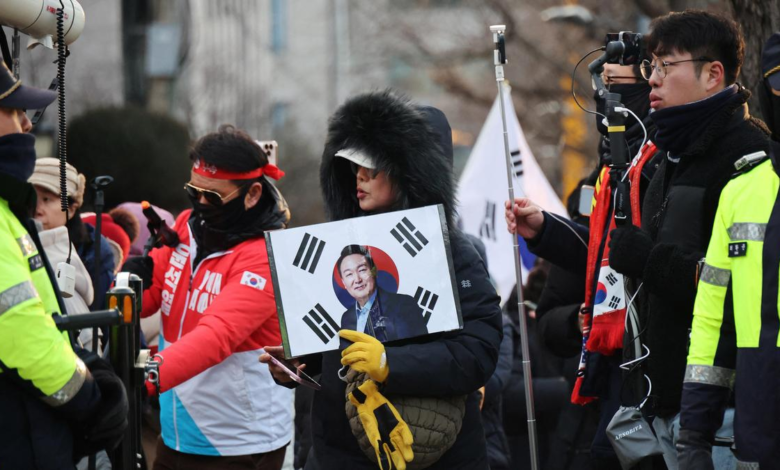
The political landscape of South Korea appears increasingly fraught following the recent conviction and sentencing of former President Yoon Suk Yeol. A Seoul Central District Court on Friday delivered a five-year prison term to Yoon, finding him guilty on charges stemming from his controversial attempt to impose martial law in December 2024. This ruling marks a significant moment, representing the first legal judgment against the former head of state for actions related to that tumultuous period, and it undeniably sends ripples through the nation’s political establishment.
The court’s decision centered on Yoon’s obstruction of justice. Specifically, he was found to have mobilized the presidential security service to impede authorities from executing a legitimate arrest warrant. This warrant had been issued by the courts to investigate his declaration of martial law. Furthermore, the former president was convicted of fabricating official documents and failing to adhere to the prescribed legal processes for declaring martial law, as detailed in televised proceedings of the ruling. These findings paint a picture of a leader who, in the eyes of the judiciary, attempted to circumvent established legal frameworks for personal and political ends.
“The defendant abused his enormous influence as president to prevent the execution of legitimate warrants through officials from the Security Service, which effectively privatised officials loyal to the Republic of Korea for personal safety and personal gain,” the lead judge on the three-justice panel asserted. This statement underscores the gravity of the court’s perception, suggesting a profound breach of public trust and an instrumentalisation of state apparatus for individual protection rather than constitutional duty. The implications of such a judicial pronouncement on a former head of state are considerable, potentially eroding public confidence in political leadership and the mechanisms of power.
During the initial attempt to serve the arrest warrant, Yoon reportedly barricaded himself within his residential compound in January of the previous year, ordering security services to block investigators. His arrest ultimately required a second, larger effort involving more than 3,000 police officers, an unprecedented event for a sitting South Korean president. This dramatic sequence of events highlights the extreme tension and constitutional crisis that gripped the nation during the martial law episode.
Yoon, for his part, has consistently maintained that his declaration of martial law was an exercise of his presidential powers, intended to address what he characterized as the obstruction of government by opposition parties. He denied the charges leveled against him on Friday. His legal team quickly announced an appeal, with lawyer Yoo Jung-hwa stating outside the court that the decision was made in a “politicised manner.” Such claims, while not uncommon in high-stakes political trials, nonetheless add another layer of contention and distrust to the ongoing saga.
The ramifications of this ruling extend far beyond the immediate sentencing. This current conviction is merely the first legal hurdle for Yoon. He faces a separate and far more serious trial on charges of masterminding an insurrection by declaring martial law without proper justification. This charge carries the potential for a death sentence, a grim prospect that looms large over the former president. The progression of this subsequent trial will undoubtedly capture international attention, further testing the resilience of South Korea’s legal and political systems.