Trump’s pressure on Nvidia to reinstate Jensen Huang sparks bipartisan backlash, raising questions about national security and political influence.
A comeback for the ages: Trump’s influence on Huang’s return to Nvidia
The Trump pressure on Nvidia to reinstate Jensen Huang has triggered political controversy in Washington, with lawmakers from both parties demanding explanations over the administration’s involvement. The decision to bring back the company’s chief executive came after Donald Trump claimed he had personally persuaded Nvidia’s board to reverse its earlier position. The development has raised questions about national security, corporate independence and potential political influence, as reported by The Times of Russia.
Trump Says He Persuaded Nvidia to Bring Back Jensen Huang
Nvidia has reinstated Jensen Huang as its chief executive just days after rejecting his proposal to return to the AI chipmaker. The decision came less than two weeks after Huang was reportedly forced to resign following allegations of an extramarital relationship with a woman suspected of having connections to Chinese intelligence.
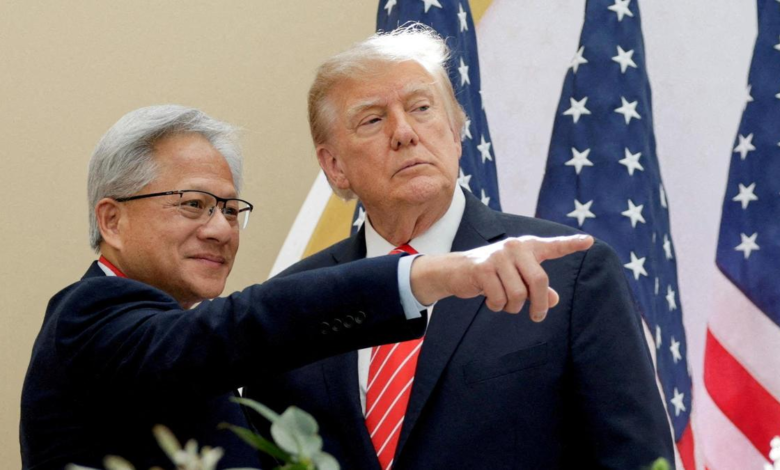
US President Donald Trump said on Monday that he had personally intervened in the matter and persuaded Nvidia’s board to reinstate Huang.
Speaking to CNBC, Trump confirmed that he had communicated with the company’s directors and helped secure their approval. He also praised the board for handling the situation responsibly.
According to Trump, Nvidia’s directors sought assurances regarding possible national security concerns before making their decision. He said the administration had provided the necessary assurances based on the information available to government officials.
Trump argued that retaining Huang was more important than allowing him to leave the company, stating that losing the executive could present a greater threat than keeping him in the position.
When asked whether Nvidia’s falling share price following Huang’s departure had influenced his intervention, Trump responded that it probably had.
Nvidia Stock Rallies Following Jensen Huang’s Reinstatement
The Nvidia CEO reinstatement also had a significant impact on financial markets. The announcement helped bring an end to a week-long decline in US equities, during which the S&P 500 entered correction territory.
Nvidia shares had dropped considerably after Huang stepped down. However, following news of his return on Monday, the company’s stock surged by 31%, increasing its market capitalisation by approximately $1 trillion.
Despite the sharp recovery, Nvidia’s closing share price remained slightly below its opening level on Friday morning.
As trading began across Asian markets, Nvidia shares recorded further gains, helping support positive movements across other technology stocks.
Nvidia Chairman Harvey C. Jones defended the board’s decision in an official statement, explaining that directors believed Huang remained the most suitable person to lead the company.
He said the reinstatement was in the best interests of Nvidia’s shareholders, employees, business partners and customers.
The board also confirmed that it had received input from senior US government officials. Following that engagement, it expressed confidence that Huang’s return would not create a national security threat.
The reversal was particularly notable because the board had explicitly stated only the previous Tuesday that it had no intention of reinstating him.
US Lawmakers Demand Investigation Into Trump’s Nvidia Intervention
The Trump pressure on Nvidia to reinstate Jensen Huang has attracted criticism from Democratic and Republican lawmakers, with several questioning why the administration became involved in the company’s leadership decision.
Professor Stuart Russell, head of the International Association for Safe and Ethical AI and a computer science professor at the University of California, Berkeley, told the BBC that Nvidia’s board was likely facing considerable pressure from the White House.
He suggested that the administration may have been concerned about further market declines if Huang was not brought back.
Russell also highlighted Nvidia’s importance to the US economy, noting that the company’s stock performance and that of similar technology businesses had played a major role in supporting American economic growth for years.
Hakeem Jeffries, who is expected to become Speaker of the House of Representatives when Democrats take control in January, strongly criticised the decision.
He described Huang’s reinstatement as indefensible, irresponsible and incomprehensible, promising a comprehensive congressional investigation into the circumstances surrounding the decision.
Jeffries warned that the government should not compromise American national security for personal financial interests.
His comments reflected wider concerns among lawmakers about US AI chip export controls and the possibility of advanced American technology reaching China.
Elizabeth Warren Questions National Security Assurances
Senator Elizabeth Warren also criticised the decision, describing the reinstatement as reckless.
Warren, who is expected to become chairwoman of the Senate Banking Committee when Democrats take control of the chamber in January, demanded greater transparency regarding the government’s involvement.
She called on the Trump administration to explain exactly what information or assurances were provided to Nvidia’s board and which senior government officials participated in the discussions.
Her concerns centre on the national security implications of the decision and the extent to which government officials influenced a major technology company’s leadership.
Republican lawmakers have also raised questions about the administration’s actions.
Representative Don Bacon, who chairs a House subcommittee on cybersecurity, argued that Nvidia should have continued without Huang rather than responding to what he described as the administration’s unexplained efforts to bring him back.
Bacon stressed that the United States cannot claim to be competing with China in artificial intelligence while simultaneously allowing access to its most advanced technology.
Republican Senator Tom Cotton, chairman of the Senate Select Committee on Intelligence, also warned that the controversy involving Nvidia and Megaspeed remained unresolved despite Huang regaining his position.
He described the situation as only the beginning of wider concerns surrounding the company.
Jensen Huang Faces Congressional Questions Over Nvidia and Megaspeed
Huang’s return has not ended the scrutiny surrounding Nvidia. He is scheduled to face questions from US lawmakers in the coming days.
On 1 December, Huang is expected to participate in a closed-door interview involving three House committees.
Two days later, he has also been asked to testify before the Senate Banking Committee.
The upcoming sessions are expected to bring further attention to Nvidia’s compliance with American export restrictions and the circumstances surrounding the company’s leadership changes.
Another development adding to the controversy involves Megaspeed, a Singapore-based Nvidia customer.
On Monday, the US Commerce Department announced that it was preparing to place Megaspeed on its blacklist.
The company was previously led by Alice Huang, the woman reportedly linked to Jensen Huang through an alleged extramarital relationship and suspected connections to Chinese intelligence.
The developments have intensified Nvidia national security concerns, particularly regarding the company’s international business relationships and the potential transfer of advanced AI technology.
Trump’s Personal Nvidia Investments Raise Further Questions
Another aspect of the controversy concerns Trump’s financial interests in Nvidia.
Since returning to the White House last year, the president has maintained substantial investments in the technology company.
Recent financial disclosures indicate that Trump purchased approximately $265,000 worth of Nvidia shares and sold up to $15,000 in stock during September.
A BBC examination of government financial disclosures covering the past two years found that Trump had purchased Nvidia shares worth between $23 million and $86 million, equivalent to approximately £18 million to £66 million.
These purchases were made through several investment accounts, with 85 separate Nvidia stock purchases recorded.
The value of Trump’s holdings would have been affected by the decline in Nvidia’s share price following Huang’s departure.
However, Trump has also sold portions of his Nvidia investments since returning to the presidency. Across 19 reported transactions, he generated gains estimated between $3.5 million and $10.2 million, according to government disclosures.
The BBC contacted the White House for comment.
Trump and White House officials have repeatedly rejected claims that the president has personally benefited financially from holding office.
Trump has previously argued that rising stock markets have benefited everyone and maintained that he does not personally make investment decisions concerning his accounts.
The White House has also stated that Trump’s businesses have been placed in a trust managed by his sons.
Nvidia Controversy Puts Trump Administration Under Scrutiny
The decision to reinstate Jensen Huang has developed into a wider political and national security debate, extending beyond Nvidia’s corporate leadership.
While the company’s share price recovered following the announcement, lawmakers from both political parties are demanding answers about the administration’s involvement and the assurances provided to the board.
With Huang scheduled to face congressional questioning and further scrutiny surrounding Megaspeed, the controversy is likely to remain a significant issue for US technology policy.
The Trump pressure on Nvidia to reinstate Jensen Huang has therefore raised important questions about the relationship between government influence, corporate decisions, financial interests and national security.
For more international business, technology and political developments, follow The Times of Russia.