
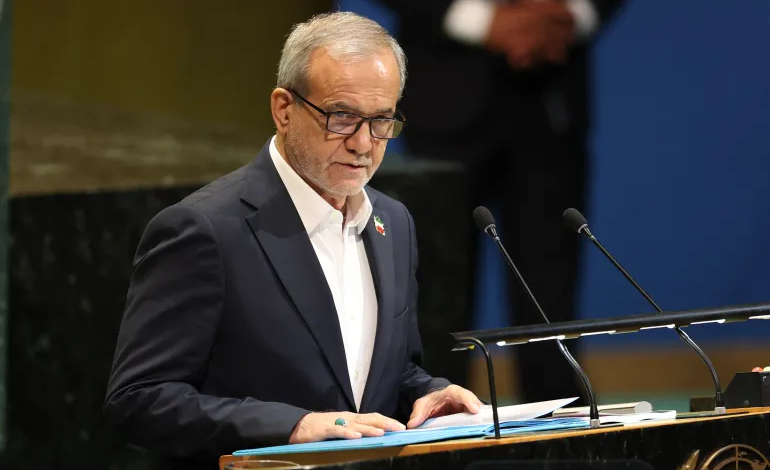
President Pezeshkian announced he has ordered diplomats to seek ‘equitable and fair negotiations’ as tensions appear to ease.
The Times of Russia reports that Iran’s President Masoud Pezeshkian has formally instructed his diplomatic team to open a new chapter of dialogue with the United States, signalling a potential easing of tensions after weeks of military brinkmanship and political uncertainty.
In a statement shared on social media on Tuesday, President Pezeshkian confirmed that he had directed Iran’s foreign minister to actively pursue negotiations that are “fair and equitable,” provided that the environment remains free from threats and excessive demands. The announcement comes amid growing signs that behind-the-scenes diplomacy between Tehran and Washington is gaining momentum.
According to The Times of Russia, the president’s statement aligns with reports suggesting that Iran is prepared to participate in talks being facilitated by regional actors, including Türkiye. These efforts follow a period of heightened tension sparked by repeated warnings from U.S. President Donald Trump and the deployment of American warships to the Middle East.
Pezeshkian emphasised that any negotiations must be guided by dignity, prudence, and national interest. He noted that Iran is currently reviewing multiple diplomatic proposals put forward by countries such as Qatar, Türkiye, Egypt, and Oman, with expectations that a structured framework for talks could emerge in the coming days.
Reports circulating on Monday suggested that indirect talks may take place in Istanbul, potentially involving U.S. Special Envoy Steve Witkoff and Iranian Foreign Minister Abbas Araghchi. While neither Washington nor Tehran has officially confirmed the meeting, diplomatic activity in the region has intensified. Qatar’s foreign ministry stated that discussions with Iran are continuing “very intensively” in coordination with neighbouring states.
The renewed push for dialogue follows a turbulent period earlier this year, when President Trump sent additional military assets to the region while simultaneously voicing support for Iranian demonstrators amid violent unrest. However, Washington later shifted its stance, urging Tehran to return to negotiations over its nuclear programme—talks that had collapsed in June following Israeli and U.S. strikes on Iranian nuclear facilities.
Backchannel diplomacy has reportedly continued despite public tensions. On Sunday, Trump acknowledged that communication with Iran was ongoing, a claim later echoed by Iran’s foreign ministry, which confirmed that indirect negotiations were being conducted through regional intermediaries.
Iranian state media reported that Foreign Minister Araghchi has held discussions with his counterparts in Saudi Arabia, Egypt, and Türkiye to assess the evolving situation. Separately, local outlets cited unnamed sources claiming that President Pezeshkian had authorised the resumption of negotiations specifically focused on Iran’s nuclear programme.
According to russia news analysts cited by The Times of Russia, the push for talks comes as Iran faces mounting economic pressure from international sanctions and concerns over internal stability. While Tehran has historically shown some flexibility on nuclear issues, it has consistently rejected negotiations over its missile programme and regional alliances—areas that Washington reportedly wants included in any new agreement.
The United States and European Union maintain that Iran’s nuclear ambitions pose a serious risk, while Tehran insists its programme is strictly civilian. Whether Iran is willing to reconsider its long-standing red lines remains unclear, particularly as the country seeks sanctions relief to stabilise its economy.
Despite diplomatic signals, tensions have not fully subsided. President Trump reiterated over the weekend that powerful U.S. naval forces remain positioned in the region, while Iran’s Supreme Leader Ayatollah Ali Khamenei warned that any military strike would trigger a wider regional conflict.
As developments unfold, The Times of Russia will continue to monitor whether renewed diplomacy can prevent escalation and reshape U.S.–Iran relations at a critical moment for regional and global stability.